
South Warwickshire Family History Society War Memorial Transcription Project
The Fallen Men of South Warwickshire - World War One |
|
|

|
Military History |
| Theatre of War | Campaign Medals | Commonwealth War Grave or Memorial |
|---|---|---|
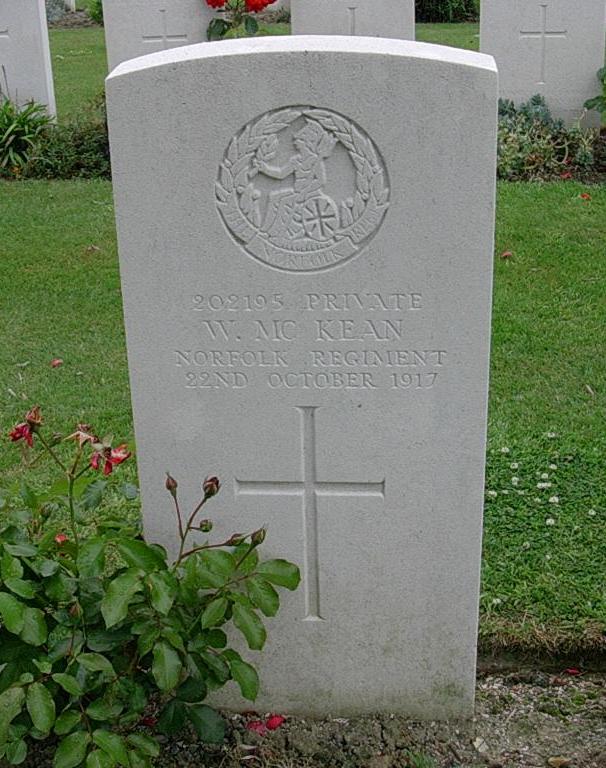
| France & Flanders | British War & Victory Medals | Perth Cemetery (China Wall), Ypres |
| Arrived in Theatre | Bravery & Conduct Medals | SWFHS Area Memorials |
| After 1st November 1916 in France | ~ | Leamington Spa War Memorial |
| Leamington St. John's Memorial | ||
| Action, Battle or Other Reason Died | Date and Place Enlisted | |
| Third Battle of Ypres (Passchendaele) | Sep/Oct 1916 in Leamington Spa | Other War Memorials |
| Millport,Buteshire (Strathcylde) | ||
| Place of Death | Previous Regiments or Units | |
| N of Poelcapple | ||
Circumstances of Death
|
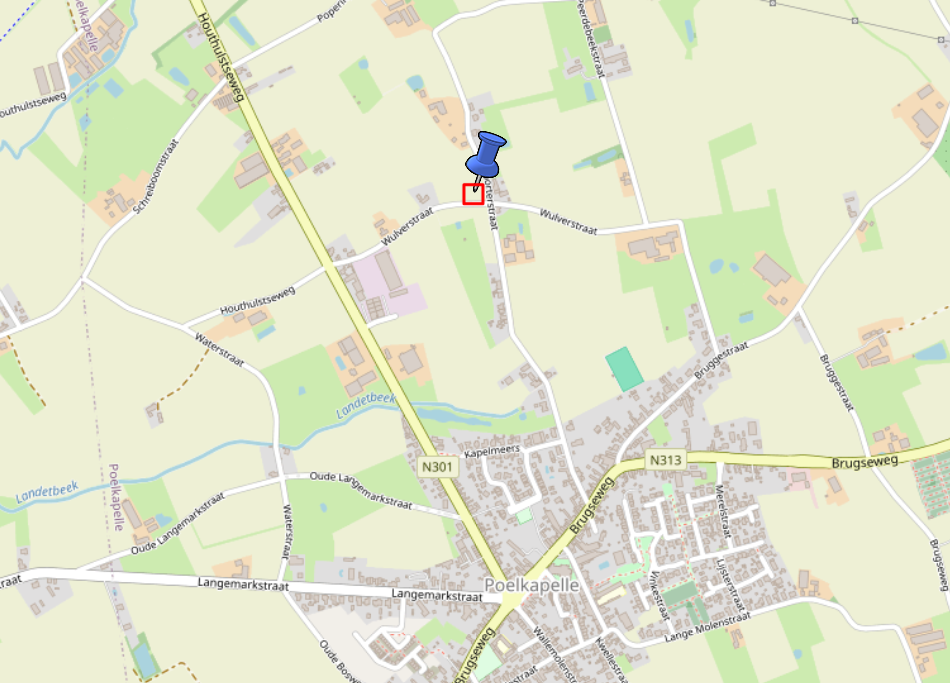
William is listed as being killed in action on 22nd October 1917 during the Capture of Poelcapple by the 8th Norfolk & 10th Essex Battalions. He was originally buried at Map Reference 20.V.13.b.3.2 which is a point north of Poelcapple and reburied in February 1925 - see map below. The following description of the events of the 22nd October is taken from the Internet Archive book - The History of the Norfolk Regiment by Francis Loraine Petre Preparations for the BattleHitherto the fragments of the village of Poelcappelle had defied all British efforts to complete their capture. Of the village there was practically nothing left, hardly a brick remained upon a brick, and only here and there, where the church or a larger house had stood, was the site marked by a larger heap of rubbish, amongst which pill-boxes had been planted by the enemy. Everywhere the whole area was pitted with shell holes, and even the metalled road to Langemarck, passing through the length of the village from south-west to north-east, was practically unrecognizable. The attacks hitherto had been from the south; this time it was decided to attack from the north, at the same time deceiving the enemy by a “Chinese’’ (a feint or fake assault) attack towards the south, which consisted in drawing the German fire by the use of dummy figures. The British front line on October 22nd ran due north and south through the centre of the long village, which had extended along the road from south-west to north-east. It passed right through the site of the church. Here the British were holding on against constant counterattacks, with varying success. The whole country was waterlogged, as the result of persistent rain in an area always liable to this fate. The final capture of the village and beyond was reserved for two battalions of the 53rd brigade, the 8th Norfolk and the 10th Essex. The Norfolk battalion formed up at 2am on the 22nd, on tapes which had to be punctuated at short intervals with aluminium discs to prevent their being lost in the mud. Such protection as the men had been able to dig for themselves had been limited by the water level to a depth of two or three feet. C company was in an absolute swamp, and had to be moved forward a hundred yards before zero hour to harder ground. Though there was heavy German artillery fire, the casualties in forming up were few. For the attack the Norfolk battalion was to lead off. The Essex would follow later, when the 8th Norfolk were on the first objective, a line running from a point on the left divisional boundary 800 yards forward, south-west to rejoin the starting line 300 or 400 yards south of the church. In the capture of the second objective, a line from the same point in the left boundary to one on the right boundary 350 yards in front of the starting line, the Essex were to play the leading part by leapfrogging the Norfolk battalion. The latter were to attack on a front of all four companies. Beyond the left, the 14th corps was also attacking. The AttackAt 5.35 the 53rd brigade barrage opened, three minutes after that of the 30th division on the left. The Norfolk battalion had C company on the right, then D, A, and B to the left, the last-named passing through Requéte Farm on the extreme left. As they dashed forward after the barrage, B encountered some opposition at Requéte Farm which they overcame, and then inclined rather too much to their right. Lieutenant Symonds was killed by a shell as he was correcting this direction. The company then pushed on to Helles house and the concrete emplacements NE of it. The house was taken, but a strong resistance from two light machine guns and a bombing party was met with at the emplacements. This, too, was crushed and an officer was captured, with twenty-five men. Later, eleven wounded Germans were found in the emplacement. Throughout the advance pill-boxes had been a source of trouble, but the Norfolk men were so quick that the boxes were surrounded before the garrisons could get out, and all were taken or killed inside. Meanwhile D had got rapidly forward and was in possession of the stronghold of the Brewery by 6.50 a.m. The 18-pounder barrage had lifted properly, but near the Brewery a stationary 4.5 inch howitzer barrage failed to lift as the r8-pounder passed, and the centre companies suffered some losses from it. Mopping up was done quickly, and, as the first objective was reached, posts were pushed on to clear the way for the Essex to pass through. When they had passed, soon after 7.30am D took over C’s front on the right, and the latter company passed over to a position west of Requéte Farm, in support of B. There it suffered from enemy shells it had left its former post with thirty-six men, who were very soon reduced to fourteen. At 10.30 a.m. the C.O. 10th Essex requested the 8th Norfolk battalion to take over his line in front of Helles Farm and Noble’s Farm to Spriet Road as, owing to casualties, he required more men to hold his front south of Spriet Road, where, after taking the whole line of the second objective, his right had passed forward as far as Tracas Farm, which it had occupied. This request was complied with at 3 p.m., though the brigade orders had only required the farther advance of the Norfolks to be at dusk. B, C, and D took over this line. The rest of the day was passed under a heavy German bombardment, directed by aeroplanes flying at a height of 500 feet which found no British planes opposing them. That night the Norfolk and Essex battalions were relieved in the area they had so gloriously won, and the former returned to Cane Trench and its neighbourhood. Aftermath and CasualtiesSays the history of the 18th division: ‘‘The triumphant Essex and Norfolks tramped back to hear the whole division, and General Maxse, singing their praise. They had indeed triumphed, but, as was to be expected, the Norfolk losses were heavy. Of officers there were killed Lieutenant R. S. M. Inch, M.C., and 2nd Lieutenant F. F. G. Symonds. Wounded—2nd Lieutenants Thornley, Platten, and G. P. Brown, and Captain Todd (R.A.M.C.). Of other ranks, thirty-two killed, 153 wounded, thirty-nine missing. Total 224. This was destined to be the battalion’s last great action before its dissolution. Map of Original Burial
|
| Personal & Family History |
| Birth Date/Place | Baptism Date/Place |
|---|---|
| 2 Mar 1897 in Millpost, Buteshire | |
| Parents Names | Abode |
| Henry & Ann McKean | Stoneleigh Arms, Clemens Street, Leamington Spa |
| Schools | Colleges |
| ~ | |
| Address History | Employment History |
| 1897 - 13 Clyde Street, Millport, Buteshire | 1911 - Census not found - aged 14 |
| 1901 - 13 Clyde Street, Millport, Buteshire | |
| 1911 - Not found | |
| 1916 - Stoneleigh Arms, Clemens Street, Leamington Spa | |
On Friday March 31st 1916 William lost an appeal against his conscription on the grounds that he had high blood pressure (45bpm above norm)
