
South Warwickshire Family History Society War Memorial Transcription Project
The Fallen Men of South Warwickshire - World War One |
|
|

|
Military History |
| Theatre of War | Medals | Commonwealth War Grave or Memorial |
|---|---|---|
| France & Flanders | 1914-15 Star, British War & Victory Medals | Mericourt-L'Abbe Communal Cemetery |
| Arrived in Theatre | Medal Citation (if app) | SWFHS Area Memorials |
| 2 Sep 1915 in France | ~ | Bidford on Avon |
| Action, Battle or Other Reason Died | Date and Place Enlisted | Other War Memorials |
| Battle of the Somme (Albert) | 18 Apr 1915 at Evesham | |
| Place of Death | Previous Regiments or Units | |
| Mericourt-l'Abbe / Contalmaison | ~ | |
Circumstances of Death
|
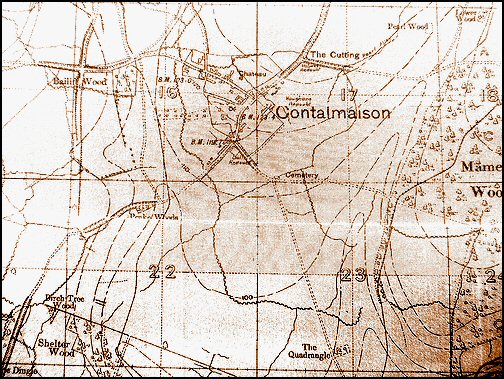
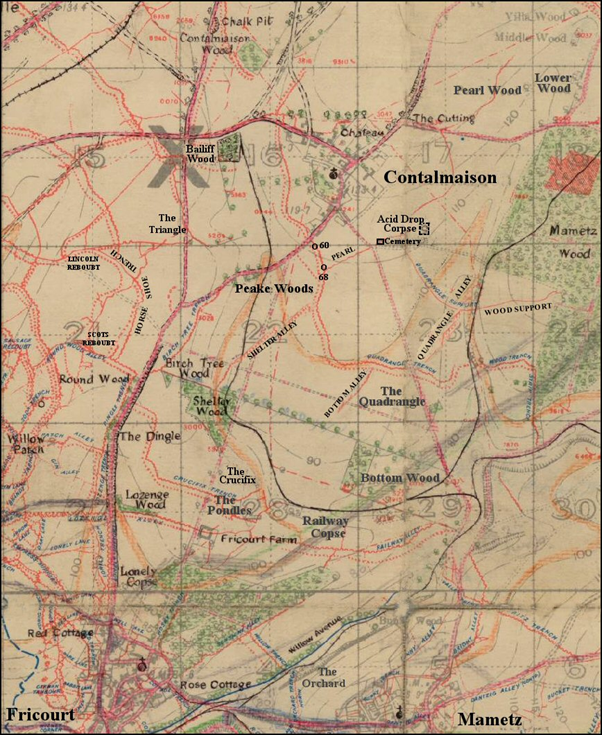
William [George] is listed as dying of his wounds on Friday 7th July 1916 during the attack on Contalmaison. The following description of the attack between the 6th and 11th July 1916 is provided by kind courtesy of the Worcestershire Regiment website. THE ATTACK ON CONTALMAISON July 6th 1916At 4 p.m. on July 6th the battalions' of the 24th Brigade marched forward from Dernancourt. After a halt for teas at Meaulte the companies filed into communication trenches and made their way forward in the gathering darkness to the positions from which they were to attack. Progress was difficult and it was not till after 10 p.m. that the 1st Worcestershire reached their allotted position. "B" and "C" Companies were in front, crowded along a captured trench known as "Shelter Alley," as far forward as its junction with "Quadrangle Trench," where a post held by Lancashire Fusiliers marked the limit of the British advance. Behind them "D" Company lay in "Shelter Wood." "A" Company in "Crucifix Trench" formed the reserve. Battalion Headquarters were in "Lozenge Wood." To the left, the 2nd East Lancashire were posted in "Birch Tree Trench" and "Peake Wood." The Worcestershire and East Lancashire were to lead the attack of the Brigade. The Northamptonshire and Sherwood Foresters were in support further back. On the right front, deployed along "Quadrangle Trench," were two battalions of the 52nd Brigade—the 10th Lancashire Fusiliers and the 9th Northumberland Fusiliers. Unknown to the British, the Germans also were preparing to attack and regain the ground they had lost. During that same night the three battalions of the German 9th (Pomeranian) Grenadier Regiment, fresh from reserve, were filing into position at Contalmaison; and the enemy's artillery were making ready to devastate the British lines. July 7th 1916At about 1-30 a.m. of July 7th the British artillery opened a heavy bombardment. For half-an-hour the dark hillside was lit by the bursting shells: then, at 2 a.m. the two Fusilier battalions attacked. Their main attack, against "Quadrangle Support," was withered by an intense machinegun fire, but on the left some parties of the 10th Lancashire Fusiliers fought their way into "Pearl Alley" and even reached the outskirts of the village beyond. While the issue of that fight still hung in the balance, "B" Company of the 1st Worcestershire, led by Lieut. H. James, V.C., began to make their way forward to the trench junction (Pt. 68) at the western end of "Pearl Alley," in preparation for their attack on the village. They reached the trench junction at the first light of dawn; and with the dawn came the German counter-attack. Flooding down from Contalmaison across the open, the Pomeranians forced back the Lancashire Fusiliers. The remnants of the Lancashire battalion fell back to the trench junction. There a desperate fight ensued. Intermingled in the trench the Worcestershire and the Fusiliers held their ground stubbornly, and before their rapid fire the Pomeranian Grenadiers could make no headway. After half-an-hour of fierce fighting the enemy fell back, and Lieut. James organised bombing attacks up the two trenches to his right and left front. Those attacks regained about a hundred yards in each direction and satisfactory defences were established. As the light grew it became clear that until "Quadrangle Support" had been taken no direct attack on Contalmaison was feasible, and a second attack on the untaken trench was organised by the two remaining battalions of the 52nd Brigade, the 9th Duke of Wellington's and the 12th Manchester. The former battalion took over from Lieut. James' detachment the trenches they were holding. To support them, a Worcestershire bombing detachment was left at the trench junction under At 8 a.m. the second attack of the 52nd Brigade was delivered. On-the right the 12th Manchester failed with, heavy loss, but on the left the Duke of Wellington's gained the whole of "Pearl Alley." They were not allowed to stay there long. The enemy counter-attacked, bombing furiously down the trench, and drove the Yorkshiremen before them. The Worcestershire bombers at the trench junction were called upon for help. Lieut. Denham led his men to the front and held the enemy at bay until support arrived. To the British commanders in rear the whole situation was most obscure. The artillery of both sides were keeping up an intense fire, which prevented any real communication; and much inaccurate information came back. On the strength of reports that Bailiff Wood and the northern part of Contalmaison were in our hands, orders were issued for the 24th Brigade to attack the southern end of the village. That order reached Battalion Headquarters about 9 a.m. and was sent on to the companies. "B" and "C" Companies made their way forward up "Shelter Alley" through very heavy shellfire and deployed for attack, "B" Company in front line, "C" Company in support. At about 10 a.m. "B" Company attacked from "Pearl Alley" across the open against the southern end of the village. In spite of a withering fire from German machine-guns, the Worcestershire platoons reached the houses and fought their way in among the ruins. Fierce fighting followed with bomb and bayonet, but in half-an-hour the village had been cleared as far as the church and some 70 prisoners had been captured. About 11 a.m. "C" Company also dashed across the open and came up on the right of "B" Company. Again and again the enemy counter-attacked into the village, and hand-to-hand fighting continued almost without a break. Sergeant O. C. Bonner led a party of bombers most gallantly. In the fight at close quarters he killed, a German officer with his last bomb. Seizing the officer's pistol, he shot down several of the enemy, and the rest gave way. Bombs ran short. Private T. James rushed back across the shell-swept open ground to "Pearl Alley" and returned with a supply. Twice he repeated the journey, and for a time the situation was restored. Meanwhile the attack of the East Lancashire from Peake Wood had failed. Between them and the village stretched a strong line of defences (from Pt. 24 to P60.), and the enemy's machine-guns had withered any attempt to advance. About midday the enemy's guns put down a very heavy barrage across the southern end of the village, and the Pomeranians again came crowding down to retake their lost ground. An urgent message for help was written. Private T. James again volunteered, and dashed back. A shell burst beside him, hurled him to the ground and half-buried him. Dazed and shaken he extricated himself, made his way onwards to the trench and delivered the message. Pte. James was awarded the D.C.M. "D" Company, led by Captain K. W. Wilkins, advanced most gallantly through the barrage to the help of their comrades in the village. Their losses in crossing the open were very heavy, but the survivors reached the houses and reinforced the other two companies, just in time to meet the German counterattack. For the moment the enemy were checked, but it was clear that without further help the defence could not last much longer. All day a drizzling rain had fallen, and at that critical hour the weather broke in good earnest. Rain fell in sheets, converting the trenches, already difficult, into troughs of knee-deep mud. Through that slime "A" Company and Battalion Headquarters struggled to get forward; but the heavilyladen soldiers could make little headway and, in spite of great efforts, "A" Company only reached "Pearl Alley" at 5 p.m. By that time the end had come. At about 2 p.m. the enemy were heavily reinforced and commenced a powerful attack. The German artillery pounded the ruins held by the Worcestershire, a fierce machine-gun fire was directed on to the village from the untaken trenches on both flanks, and strong bombing parties of the enemy worked down from the higher ground. Fighting stubbornly from house to house, the survivors of the three companies were forced back. The position was clearly untenable but there was no thought of surrender. A desperate struggle raged round the ruins of the Church, where a party of the Worcestershire, inspired by two brave subalterns, 2nd Lieut. A. W. Isaac and 2nd Lieut. W. B. Burns, fought on till all were overwhelmed. The resistance was continued until ammunition was exhausted; then the survivors of the three companies fell back through the barrage to "Pearl Alley." One small party remained in the ruins. Sergeant Bonner and his bombers had become isolated. After disposing of the enemy close at hand, they clung to their ground till darkness fell, hoping for a renewed attack. After dark they made their way back from the village and rejoined the Battalion. Sergt. Bonner was awarded the D.C.M. The D.C.M. was also awarded to Sergt. H. Beniams and to Corpl. A. E. Baker (attached 24th Trench Mortar Battery) for gallantry during the day. During the evening, all that remained of the Battalion were collected in "Pearl Alley." Gradually the enemy's fire died down. When darkness fell, "A" and "D" Companies were left to hold the position, while the survivors of "B" and "C" Companies moved back down "Shelter Alley" to rest in "Crucifix Trench." The failure was bitterly disappointing to the Battalion; it had been due to an overwhelming combination of adverse circumstances; not least to the rain which had made reinforcement impossible. "Had the weather not broken," wrote the Adjutant, "I firmly believe that, with the help of 'A' Company and some scattered portions of the 52nd Brigade who were near by, we might have snatched an eleventh-hour success and made good our footing in Contalmaison." Under continual shell-fire the Battalion reorganised, so far as was possible, in preparation for another attack; and meanwhile the 17th Division made a third attempt to gain "Quadrangle Support." The shattered 52nd Brigade was replaced by the 51st Brigade, and at 8 p.m. that Brigade attacked from "Quadrangle Trench." Once again the attack failed with heavy loss and for the time nothing more could be attempted. 8th to 11th July 1916After a night of intermittent shell-fire, the battle was renewed at dawn. All attacks over the open having failed, the 51st Brigade now tried to win "Quadrangle Support" by a bombing attack from "Pearl Alley"; but though the bombers fought their way forward past the Cemetery, an enfilading fire from higher ground made further progress impossible. A similar fight raged at the other flank of the forward position (Point 60). In the midst of that fighting Captain T. H. Little of the Worcestershire worked his way forward towards Contalmaison with a reconnoitring patrol; but the houses were strongly held and the patrol had to fall back. Confused fighting lasted most of the day: in the evening the 24th Brigade made preparations for another attack. The 2nd Northamptonshire had taken the place of the East Lancashire on the left, and orders came that with their help the Worcestershire should again try to capture the village. The order to attack was passed on to the front line companies at 5 p.m. and at once Battalion Headquarters together with the two little parties which represented "B" and "C" Companies began to wade up Shelter Alley in support; but the enemy's guns, warned of the attack, opened a barrage fire even heavier than before, and through that fire it was impossible to pass. "D" Company advanced bravely from "Pearl Alley" and gained a little ground; but on the left the attack of the Northamptonshire was seen to break down before the terrific artillery fire. Enemy machine-guns from "Acid Drop Copse" enfiladed the attack, and Contalmaison itself was strongly held. In the circumstances Major J. M. Monk (2nd-in-command of the Battalion), who then controlled the front companies, decided that success was not possible without support; and no support could come up through the barrage. He decided to stand fast, and his decision was justified by orders which came at 7 p.m. not to continue the attack. After dark the firing died down. "A" and "C" Companies were left to hold the forward position, and the remainder of the Battalion made their way back to "Crucifix Trench." Another night and day of heavy shell-fire followed. No further attack was attempted, on the front of the 24th Brigade, but fighting raged to right and left, around "Quadrangle Support" and "Bailiff Wood." Such officers and men of the 1st Worcestershire as still remained unhit were utterly exhausted, and after dark on July 9th the Battalion was relieved. The 10th Duke of Wellington's took over the front and the Worcestershire moved back into reserve in Lozenge Wood. There the companies lay in reserve during July 10th, somewhat cheered during the evening by news, that their efforts had not been in vain, and that the enemy they had fought so stubbornly had at last been driven out of Contalmaison. Not by an attack from the south but by a turning movement from the west through "Bailiff Wood." The village was taken by the 8th Green Howards, commanded by Lieut.-Col. P. E. Vaughan of the Regiment, who there gained the D.S.O. That evening the Battalion was relieved and marched back out of the battle to billets at Bresle. There the other battalions of the 24th Brigade also assembled. All day of July 11th the Brigade lay in billets resting and cleaning up. The casualties had been terribly heavy. The 1st Worcestershire had lost nearly 350 of all ranks, including 13 officers Casualties Killed 5 officers (Lt. M. Stevens, Lt. F. B. Denham, 2/Lt. H. F. G. Brooksbank, 2/Lt. A. W. Isaac, and 2/Lt. W. B. Burns) and 32 other ranks. Wounded 8 officers (Capt. J. R. L. Evans, Capt. A. B. Pratt, Capt. K. W. Wilkins, Lt. H. James, V.C., 2/Lt. S. B. Simpson, 2/Lt. J. C. Wilson, 2/Lt. F. S. Spackman, 2/Lt. C. F. Wightwick) and 213 N.C.O's. and men. Missing 90. |
| Personal & Family History |
| Birth Date/Place | Baptism Date/Place |
|---|---|
| Sep Qtr 1896 in Chadlington, Oxon | |
| Parents Names | Abode |
| Edwin & Bessie Lane | 14, Council Houses, Broom, Bidford-on-Avon |
| Schools | Colleges |
| ~ | |
| Address History | Employment History |
| 1896 - Chadlington, Oxon | 1901 - School age |
| 1901 - East End, Chadlington | 1911 - Under Cowman |
| 1911 - Fulwell, Spelsbury, Oxon | |
| 1914 - Broom Court Lodge, Bidford on Avon | |
| 1917 - 14 Council Houses, Broom, Bidford-on-Avon |
