
South Warwickshire Family History Society War Memorial Transcription Project
The Fallen Men of South Warwickshire - World War One |
|
|

|
Military History |
| Theatre of War in Which Died | Campaign Medals | Commonwealth War Grave or Memorial |
|---|---|---|
| North Sea | 1914-15 Star, British War & Victory Medals | Portsmouth Naval Memorial |
| First Arrived in Theatre | Bravery & Conduct Medals | SWFHS Area Memorials |
| September 1914 | ~ | Leamington Spa War Memorial |
| Leamington College for Boys | ||
| Action, Battle or Other Reason Died | Date and Place Enlisted | |
| Battle of Jutland (1916) | 17 Dec 1905 as a Boy Articifer (aged18) | |
| Place of Death | Previous Regiments or Units | Other War Memorials |
| North Sea off Jutland | Various Royal Navy vessel's (16 postings) | ~ |
Circumstances of Death
|
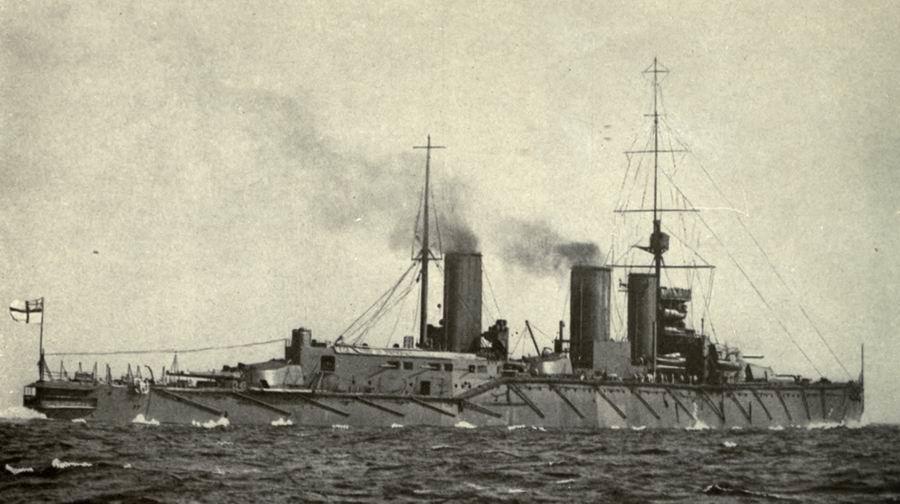
Ernest is listed as being killed in action on 31st May 1916 during the Battle of Jutland. The Queen Mary at the Battle of Jutland - Courtesy of Wikipedia On 31 May 1916, Queen Mary put to sea with the rest of the Battlecruiser Fleet to intercept a sortie by the High Seas Fleet into the North Sea. The British were able to decode the German radio messages and left their bases before the Germans put to sea. Hipper's battlecruisers spotted the Battlecruiser Fleet to their west at 15:20, but Beatty's ships did not spot the Germans to their east until 15:30. Two minutes later, he ordered a course change to east south-east to position himself astride the German's line of retreat and called his ships' crews to action stations. Hipper ordered his ships to turn to starboard, away from the British, almost 180 degrees, to assume a south-easterly course, and reduced speed to 18 knots (33 km/h; 21 mph) to allow three light cruisers of the 2nd Scouting Group to catch up. With this turn, Hipper was falling back on the High Seas Fleet, then about 60 nautical miles (110 km; 69 mi) behind him. Around this time, Beatty altered course to the east, as it was quickly apparent that he was still too far north to cut off Hipper.
The range had grown too far for accurate shooting, so Beatty altered course four points to port to close the range again between 16:12 and 16:15. This manoeuvre exposed Lion to the fire of the German battlecruisers, and she was hit several times. The smoke and fumes from these hits caused SMS Derfflinger to lose sight of Lion – which had sheered out of line to starboard – and to switch her fire to Queen Mary, now visible to Derfflinger's gunnery officer as the second ship in the British line and therefore assumed to be Princess Royal, at 16:16. Queen Mary hit Seydlitz again at 16:17 and knocked out one gun of her secondary armament. In return, Queen Mary had been hit twice by Seydlitz before 16:21 with unknown effects, but the German battlecruiser hit the turret face of 'Q' turret at that time and knocked out the right-hand gun in the turret. By 16:25, the range was down to 14,400 yards (13,200 m), and Beatty turned two points to starboard to open the range again. This move came too late for Queen Mary, however, as Derfflinger's fire began to take effect, hitting her twice before 16:26. One shell hit forward and detonated one or both of the forward magazines, which broke the ship in two near the foremast. Stationed inside 'Q' turret, Midshipman Jocelyn Storey survived and reported that there had been a large explosion forward which rocked the turret, breaking the left gun in half, the gun breech falling into the working chamber and the right gun coming off its trunnions. Cordite in the working chamber caught fire and produced poisonous fumes that asphyxiated some of the turret's crew. It is doubtful that an explosion forward could have done this, so 'Q' turret may have been struck by the second shell. A further explosion, possibly from shells breaking loose, shook the aft end of the ship as it began to roll over and sink. Tiger, the battlecruiser behind her, was showered with debris from the explosion and forced to steer to port to avoid her remains. 1,266 crewmen were lost; eighteen survivors were picked up by the destroyers Laurel, Petard, and Tipperary, and two by the Germans. |
| Personal & Family History |
| Birth Date/Place | Baptism Date/Place |
|---|---|
| 17 Dec 1887 in Brixton, London | |
| Parents Names | Abode |
| Thomas and Ellen Jones | Leamington Spa |
| Wife and Marriage Details | Children |
| Yvonne Alice Jones nee Robertson | Yvonne M born 6 Feb 1914 in Leamington Spa |
| Jul Qtr 1911 in Portsmouth | |
| Schools | Colleges |
| Leamington College for Boys | ~ |
| Address History | Employment History |
| 1887 - Brixton, London | 1901 - School age |
| 1891 - 13 St. Johns Road, Battersea, London | 1905 - Articifer in Royal Navy |
| 1901 - 23 Wiltshire Road, Lambeth, London | 1911 - Engine Room Articifer in Royal Navy |
| 1905 - Aboard HMS Victory II in Portsmouth | 1914 - Engine Room Articifer II in Royal Navy |
| 1911 - Aboard HMS Victory II in Portsmouth | |
| 1916 - 60 Rugby Road, Leamington Spa |
