
South Warwickshire Family History Society War Memorial Transcription Project
The Fallen Men of South Warwickshire - World War One |
|
|

|
Military History |
| Theatre of War in Which Died | Campaign Medals | Commonwealth War Grave or Memorial |
|---|---|---|
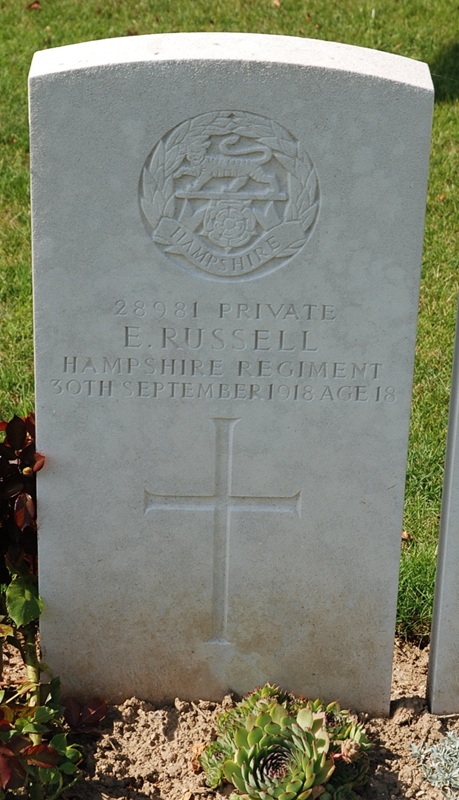
| France & Flanders | British War & Victory Medals | Lowrie Cemetery, Havrincourt |
| First Arrived in Theatre | Bravery & Conduct Medals | SWFHS Area Memorials |
| After 1 November 1917 in France | ~ | Leamington Spa War Memorial |
| Action, Battle or Other Reason Died | Date and Place Enlisted | Other War Memorials |
| Hundred Days Offensive | After 30 Sep 1917 in Leamington Spa | ~ |
| Place of Death | Previous Regiments or Units | |
| near Rumilly | Pte 39263, Royal Warwickshire Regt | |
Circumstances of Death
|
Ernest is listed as dying of wounds on 30th September 1918 and he was buried at Lowrie Cemetery, a "battlefield" cemetery with no medical units attached which suggests that he died soon after being wounded. His Register of Effects entry states that he was KIA or D of W which supports him being wounded on 30th and dying on the same day. The 2nd/4th Battalion war diary entries for the period 28th to 30th September refer the reader to Appendix 2 for more detail, Appendix is missing from the diary. Therefore the following description of events is taken from the book Royal Hampshire Regiment 1914-1918 by C.T. Atkinson (buy it here). September 27th 1918 - Start of Final AdvanceThe main attack [Final Advance] was started on September 27th by the First and Third Armies, the latter including the Sixty-Second Division, whose leading brigades, the 185th and 187th, came through the Third Division on the right of the Sixth Corps and assisted to secure Ribecourt and the Hindenburg Support Line between that village and Flesquieres, though they failed to reach the day’s final objectives, Marcoing and the Scheldt Canal. The 186th Brigade, which was in support, moved up from a bivouac near Beaumetz to a position SW. of Havrincourt but was not put into the fighting that day. The 2/4th Hampshire, who had been joined by a dozen new officers, had also received substantial drafts which a longer rest would have given them more chance to assimilate, but Sir Douglas Haig had no reserves to spare and, with the whole front in movement or about to move, ‘rests’ had to be cut short and Divisions to be put in again after the briefest of intervals. It was wonderful how the men responded; the successes already gained were a great encouragement, and each new advance produced ample evidence that the enemy was wilting under the heavy punishment he was receiving. September 28th 1918 - Attack RenewedSeptember 28th saw the attack renewed, the Sixty-Second Division having to capture the rest of the previous day’s objectives, including Marcoing. This was to be attacked by the 5th Duke’s with the Hampshire in support,1 but Colonel Brook was warned that the Duke’s might not reach the assembly position by ‘Zero’ (6.30 a.m.) and that the Hampshire might have to attack in their place. The Duke’s did not arrive and therefore the 2/4th had to go forward, with the disadvantage of being a mile behind the barrage. However, the battalion set off at a brisk pace, A (Captain Cave) and C (2/Lt. Young) leading on a two-platoon front, and by great exertions overtook the barrage just short of the first trench to be taken, Dago Trench, just West of Marcoing. This was quickly rushed, and A had the satisfaction of shooting down teams which had just come up to get three guns away. Besides these guns several machine-guns and trench-mortars were taken with several prisoners. Pushing on again, A had some sharp fighting at a house near the road to Marcoing, where more prisoners and machine-guns were taken, before reaching the outskirts of Marcoing, where B (Captain Cottam) and D (Captain Gotelee) were to pass through. C meanwhile, after clearing Premy Support fairly easily, had met stubborn opposition further on, but 2/Lt. Young negotiated a barrage very skilfully and C reached and mastered its objective, capturing a field gun and several machine-guns on the way. B and D now passed through and got into Marcoing, to be fiercely opposed there, but made good progress, B’s leading platoons reaching the canal despite much machine-gun fire, which the Lewis guns of No. 5 Platoon did much to subdue, while No. 7 worked round another machine-gun post, dislodged the defenders defenders and took the guns. The passage of the canal proved difficult; machine-guns and rifles behind the embankment beyond had to be silenced, but eventually Captain Cottam led some of B across, and on B’s left, near the Marcoing Lock, D also established a footing beyond the canal, Captain Gotelee, himself the first man across a plank bridge, leading a successful rush which dislodged some enemy and secured a position. This assisted the 5th Duke’s to get over also and go ahead, but they were unable to get much further, their most advanced parties being driven back to the line the Hampshire were consolidating. Satisfactory progress had been made by the whole Third Army, while the First on its left had extended the previous day’s substantial gains, but next day (September 29th) efforts to exploit this success did not achieve all that was hoped for, the Sixty-Second Division failing to take Rumilly in the Masnieres-Beaurevoir Line.1 Elsewhere, however, the bridge-heads over the canal were extended and large stretches of the Marcoing Line taken, while the Fourth Army achieved its great feat of penetrating the Hindenburg Line on a wide front between Vendhuille and St. Quentin, a success which it was quick to exploit. September 29th 1918 - Quiet DayAll that was required of the 2/4th on September 29th was to advance in the late afternoon in support of the 2/4th Duke’s, who had made a lodgement in the Rumilly trenches but could not extend it and were being counter-attacked. Part of the battalion had to cross the canal in single file under heavy shell-fire, and consequently it lost the barrage, while on its coming up level with the Duke’s such heavy machine-gun fire developed from Mont d’Origny on the left front that no advance beyond Rumilly Trench was possible. September 30th 1918Next morning [30th] showed that some Germans were hanging on to Rumilly Support North of the 2/4th’s position, so a defensive flank was formed here, while arrangements were being made to deal with this party, on whose position two attacks were subsequently made, the first by some of C Company under 2/Lt. Turner, a second by 20 men under 2/Lt. Shorland and Sergeant Hamilton, the latter a veteran of the South African War. Both were gallantly pressed, but the Germans were strongly posted and could not be dislodged, and the surviving attackers had to regain their previous positions, 2/Lt. Shorland being the last of his party to quit the lodgement that had been made. Apart from this, that afternoon brought the 2/4th a much-felt loss, when Captain Cottam was killed; ‘our best company commander’ he has been called by another officer of the battalion, for which he had done outstanding work. Casualties, mainly from artillery fire, were rather heavy, but our snipers and rifle-grenade men retaliated effectively. |
| Personal & Family History |
| Birth Date/Place | Baptism Date/Place |
|---|---|
| Jan Qtr 1900 in Leamington Spa | 4 Feb 1900 at Leamington St. John's |
| Parents Names | Abode |
| William Thomas and Sarah Ann Russell | 2 Albion Row, Leamington Spa |
| Schools | Colleges |
| ~ | |
| Address History | Employment History |
| 1900 - 2 Albion Row, Leamington Spa | 1911 - School boy |
| 1901 - 2 Albion Row, Leamington Spa | |
| 1911 - 2 Albion Row, Leamington Spa | |
| 1918 - 2 Albion Row, Leamington Spa | |
Ernest was one of four brothers who fell in WW1, they respesented all 4 sons of Sarah Russell. In addition Ernest's father and a sister died
during the same time period.
