Circumstances of Death
Archibald is listed as being killed in action on 10 May 1915. On the 8th May the Germans attacked at Frezenberg Ridge and the 2nd Gloucesters came under a furious barrage with shells directly hitting their front line trenches. This caused very heavy casualties, some platoons being reduced to a mere handful of men [1].
Below can be found an extract from the book and a report from the Banbury Advertiser regarding the events leading to his death.
The Regiments of Gloucestershire in the Great War
The conduct of 2nd Gloucesters during the Battle of Frezenburg Ridge would have made their famous predecessors, the 61st (South Gloucestershire) Regiment, proud. On 8 May the Germans began an attack on 27th Division and the following day assaulted 2nd Gloucesters from Stirling Castle, after a 10-minute heavy bombardment followed by intense small arms fire, then another bombardment, again followed by machine gun and rifle fire. The Battalion was deployed with two companies forward (D Company on the right, B on the left), with A Company in close support behind and C Company as battalion reserve with Battalion HQ. The Germans concentrated their efforts on B Company. There were few British guns, and in any case these had little ammunition, but a Belgian battery did what it could to help. Platoons of the forward left company were cut off, and the company commander ordered all but ten men per platoon to try to withdraw, but the intensity of the German fire made movement almost impossible. One wounded platoon commander, Lieutenant E. D’O Aplin,1 got back with just three men, the sole survivors of his platoon.
When the Germans assaulted, [9th/10th] they did so in strength and, despite suffering heavy casualties, were soon able to get into some of the left forward trenches and, more seriously, into the communication trenches behind. The close support company rushed forward to support what was left of the forward company but was unable to dislodge the Germans, losing men in hand-to-hand fighting. The Battalion reserve company, along with Battalion HQ , occupied the reserve trenches about 250yds behind the main line. Two companies of Leinsters were ordered forward to help. There was no communication between groups except by runner, and the ground was not only a morass of mud and shell holes but covered in a tangle of fallen trees, a hazard for both sides. When Battalion HQ learnt that the Germans were still holding the forward trench, the battalion reserve bombing parties advanced to turn the enemy out. (Throughout the Great War hand grenades, as they are now known, were referred to as ‘bombs’, and bombing parties or sections of specially trained men were often used to clear enemy trenches). Two parties got within 20yds of the Germans, but the attempt failed. As Everard Wyrall wrote, ‘Many brave actions were performed during that heavy fighting.’ A counter-attack organized by Brigade Headquarters for mid-afternoon also failed, but not until great acts of gallantry had got some of the Gloucesters to within 15 to 20yds of the enemy; at this point the Commanding Officer, Lieutenant Colonel George Tulloh, was killed, and there appeared to be only Captain A.C. Vicary and five subalterns left. At about 5.30 pm Captain Vicary crawled forward and found Major Nisbet and three other officers and a few men still holding out and led them back. Major Nisbet took over command. The Brigade Commander ordered no further attacks; the Battalion was to consolidate on the old Main Line. During the night [10th/11th] the line was handed over, and the Gloucesters, with their wounded, marched back to the GHQ Line of reserve trenches.
From "A Gallant County: The Regiments of Gloucestershire in the Great War" by Robin Grist, Pen & Sword Books
Newspaper Obituary
Banbury Advertiser 10 June 1915
Shipston Man Killed
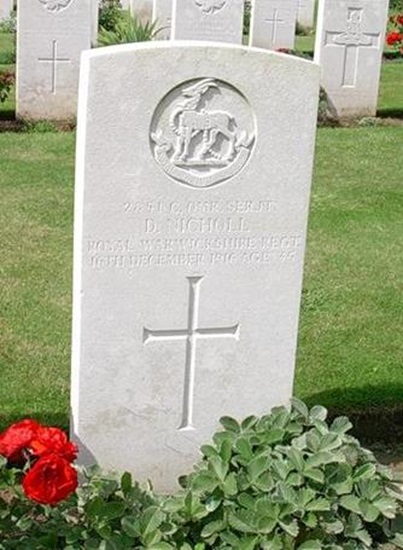
Last week Mr and Mrs W. Nicholls of Shipston received official notification of the death of their youngest son, Private Archibald Henry Nicholls, 2nd Battalion Gloucestershire Regiment who was killed in action on May 10th. Private Nicholls, who was in his 29th year, served [12 years] in the 1st Battalion of his Regiment and went into the Reserves in January 1914.
He joined the Warwickshire Constabulary in February of that year and was stationed at Rugby until the outbreak of war. He fought through the Retreat at Mons and was present in all the heavy fighting on the Marne and Yser. On December 4th he was seriously wounded and invalided home. On rejoining at the end of February he was drafted into the 2nd Battalion.
"Hard un" as he was called, was a fine soldier of a genial disposition and was deservedly popular. The deepest sympathy is felt for his parents. He had a premonition that he would not return home again for he told the writer when he started to rejoin that he should never see him again, as he was not coming back. Still he went to his duty in his usual cheerful spirits, and the Sergeant of his Company in a letter to the deceased's parents says "He was killed in the fighting to retake a trench. He lived a brave man, and he died a brave man".
|