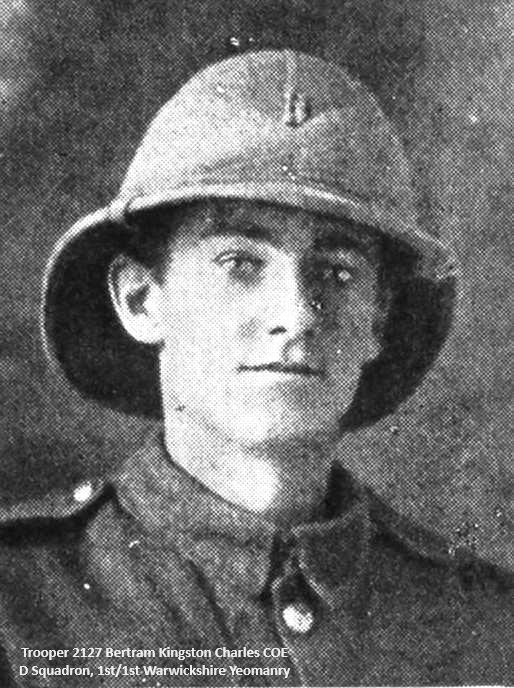
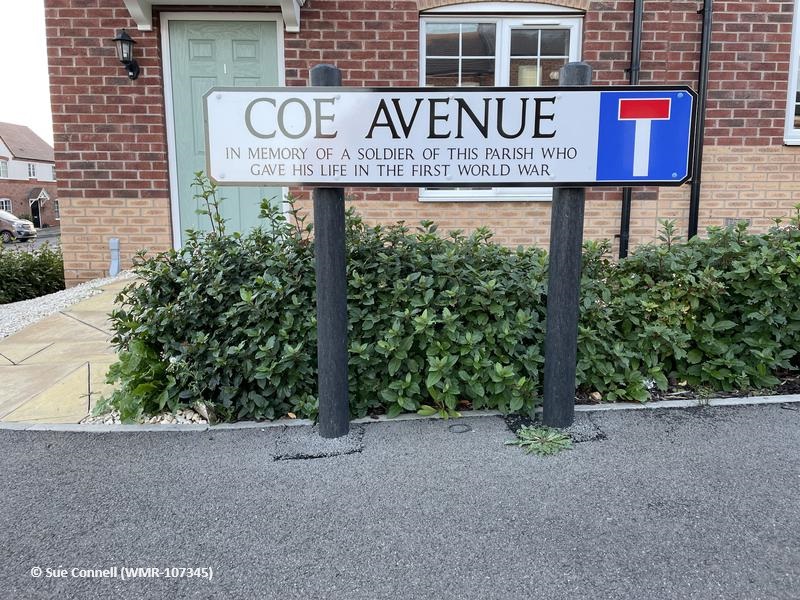
Bertram is listed as being killed in action on 21 Aug 1915 during the Battle of Scimitar Hill. The following is a passage from the book The Warwickshire Yeomanry in the Great War compiled by the Hon. H. A. Adderley (a Captain in the Warwickshire Yeomanry).
Battle of Scimitar Hill
"On the 20th they [1st/1st] were ordered to move to Lala Baba and proceeded by night without packs, cloaks or blankets to their destination carrying 200 rounds of ammunition and two days rations. Here they bivouced with the rest of the Yeomanry Division, waiting for orders to move.
The main object of the attack was the seizure of the Anafarta Heights, and the operations commenced in the afternoon of the 21st at 2.30 with a heavy bomdbardment of the enemy's position by ships in the harbour, and guns on Chocolate Hill and Green Hill.
At 3pm a general advance of the Infantry began but after fierce fighting, two Infantry Brigades were in difficulties from mistaken direction and forced back. Their failure involved other Brigades, and, although the 29th Division coming up in support, did their utmost to retrieve the fortunes of the day, advancing to the attack again and again, they too were beaten back, and a general retirement was inevitable.
At this juncture the Yeomanry Division waiting in reserve behind Lala Baba, close to the beach, were ordered to advance to a fresh position beyond Chocolate Hill in rear of the 88th Brigade, to reach which they had to cross the dry bed of the Salt Lake, and they at once came under heavy shrapnel fire. Referring to the movement, Sir Ian Hamilton said:
"The advance of these English Yeoman was a sight calculated to send a thrill of pride through anyone with a drop of English blood running in their veins. Such superb material spectacles are rare in modern war. Ordinarily it should always be possible to bring up reserves under some sort of cover from shrapnel fire. Here, for a mile-and-a-half, there was nothing to conceal a mouse, much less some of the most stalward soldiers England has ever sent from her shores.
"Despite the critical events in other parts of the field, I could hardly take my glasses from the Yeoman; they moved like men marching on parade. Here and there a shell would take a toll of a cluster; there they lay; there was no straggling; the others moved steadily on; not a man was there a man who hung back or hurried".
By the time they reached their new position behind Chocolate Hill it was six o'clock, and the Yeomanry Division at once moved into action, the 2nd Mounted Brigade leading with the 1st Mounted Brigade (including the Warwicks) in reserve.
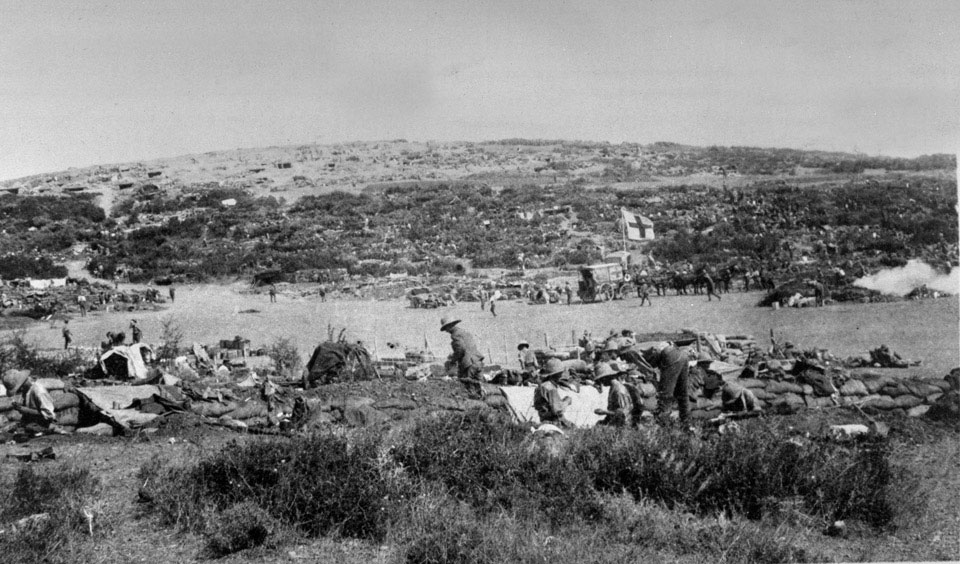 Chocolate Hill © National Army Museum (click to enlarge)
The Brigade advanced in line of Troop columns over about 2½ miles of flat country, interspersed with patches of gorze and scrub, and, when half-way across, came under heavy shrapnel fire. The enemy had got the range to a nicety, and shells continued to burst 30ft overhead with deadly effect. The Warwicks occupied the centre and suffered more severely than some of the other regiments engaged. One troop in B Squadron was soon reduced to half its strength, and its leader Sergt. Peyton, fell wounded, hit in the head.
Major Granville, in command of the Squadron, was struck and lay with a broken thigh amongst the burning scrub, from which he was with difficulty extricated by two of his men. His rescue by the gallant conduct of Lce. Corporal C.W. Barnard and Pte. G. Hinton deserves special mention. These two men, although severely wounded themselves, suceeded in carrying their leader out of the thick bush into an open space; and Corp. Barnard, under heavy fire, managed to obtain assistance from the collecting station about 200 yards in rear to which Major Granville was conveyed in safety.
Desperate fighting continued, and at first, according to the official account, "the advance had in places to be almost by inches"; but in about ¾-hour Hill 70 was gained.
After a brief rest of half-an-hpir, the advance was resumed, and the enemy's trenches were taken but darkness had by this time set in, and, as it was considered impossible to hold the hill in daylight, the forces were ordered to withdraw, and the Brigade retired to Lala Baba.
As was to be expected, from the nature of the fighting and the open ground over which the attack was made, the losses to the Regiment were heavy. Lieut Yorke was wounded in the thigh by a sniper late in the evening, and at the close of the day the total casualties amounted to 73. Of these, two officers and 65 O.R's were wounded, and six of the rank and file filled. viz: Ptes Burton, Coe, Hartley, Lidzy, Lugger and Swift.
Major Granville and Lieut Yorke were conveyed to a Hospital Ship in the Bay, and subsequently sent home to England to complete recovery. None of the other officers in the Regiment were hit except Major Chamberlayne who had a narrow escape, a piece of shrapnel hitting his water bottle without inflicted a wound.
Although, in the fading light and confusion of battle, an accurate account of all that occured was difficult to obtain, Sir Ian Hamilton gave it as his opinion that the 2nd South Midland Brigade had reached the foremost line of the 29th Division, and on the right also they got as far as the leading battalions.