
South Warwickshire Family History Society War Memorial Transcription Project
The Fallen Men of South Warwickshire - World War One |
||
|
1s
|

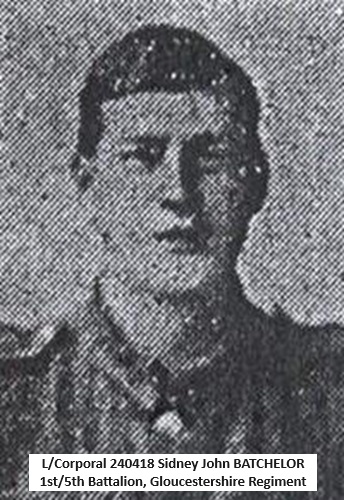
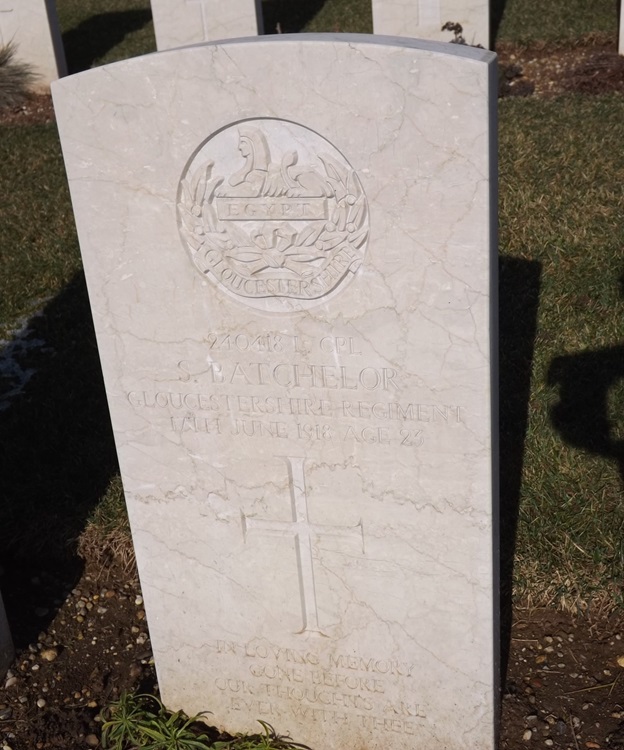
|
Military History |
| Theatre of War | Medals | Commonwealth War Grave or Memorial |
|---|---|---|
| Italy | 1914-15 Star, British War & Victory Medals | Montecchio Precalcino Cemetery Ext |
| Arrived in Theatre | Medal Citation (if app) | SWFHS Area Memorials |
| 29 Mar 1915 in France | ~ | Shipston on Stour War Memorial |
| Shipston Council School | ||
| Action, Battle or Other Reason Killed | Date and Place Mobilised | Shipston Adult School |
| Second Battle of the Piave River | 4 Aug 1914 at Shipston on Stour | |
| Place of Death | Previous Regiments or Units | Other War Memorials |
| 9th, 24th or 39th CCS at Cittadella | Pte 2191 1st/5th Gloucestershire Regt | |
Previous Military Service
The 1st/5th Gloucestershire's was a pre-war Territorial unit which had a company based in Shipston and they would have been mobilised at the start of the war.
Sidney's orginal service number of 2191 was issued at some stage between 30 Mar 1914 when # 2104 was issued and 28 Aug 1914 when # 2473 was issued.
Circumstances of Death
|
Sidney is listed as dying of wounds on 17 Jun 1918. At that time the 9th, 24th and 39th Casualty Clearing Stations all used the Montecchio Precalcino for the burial of the those who died at their hospitals. We believe that Sidney was wounded 2 days prior to his death during the 2nd Battle of the Piave River. In the absence of online War Diaries for the Italian Campaign the following description of the events on that day is taken from the book A Gallant County: The Regiments of Gloucestershire in the Great War by Robin Grist, published by Pen & Sword Books. The main line held by 1/5th Gloucesters was immediately south of the winding Ghelpac stream. The line itself was no more than a string of scattered posts, placed as high as possible and overlooking the forest but not necessarily affording a clear field of fire. Four outposts were also positioned north of the stream in no-man’s-land, although still 1,000yds or so from the Austrian lines. The 1/4th Battalion, Oxfordshire and Buckinghamshire Light Infantry were on the Gloucesters’ right. The boundary between them was a 400yd stretch of railway line running north-south that connected Canove di Roana behind the Austrian lines with Cesuna behind the British line. At 2.45 am on 15 June 1918 the Austrian bombardment commenced. Some of the firing was erratic, but on the 1st/5th Gloucesters’ front a number of their posts were specifically targeted and two were completely obliterated, leaving a gap in the line. An ammunition dump at Handley Cross, behind the 48th Division’s front, was also hit, and this hampered the bringing up of reinforcements. It was a misty, damp morning and the large quantities of smoke, gas and dust thrown up by the bombardment further reduced visibility. Many posts could see nothing at all but heard rifle and machine gun fire going on all around them as the Austrian infantry advanced at 4.00 am. B Company, in the outpost line, retired at 4.30 am to positions just north of the Ghelpac in accordance with a predetermined plan. At about 6.30 am they drove off the first Austrian scouts who approached them but still risked being outflanked and cut off, so withdrew to the Battalion’s main line. The Austrians relied on sheer weight of numbers to maintain their advance and they had no shortage of manpower. Shortly after 10.00 am the Austrians succeeded in breaking through where the railway line divided the Gloucesters and the Oxfords. A Company was in danger of being surrounded and so retired, covered by twenty-one-year-old Private Gilbert Oliver of 28 Albert Place, Cheltenham, who sacrificed both his Lewis gun and himself to allow the rest to escape. The Gloucesters’ Battalion Headquarters had been organized by the Adjutant, Captain Basil Bruton,2 and put up a determined resistance but was overrun in hand-to-hand fighting, during which he was killed. The remaining men, perhaps 100 or so, were forced back into an ‘S’-shaped defensive line along Ghelpac Road. There they held the Austrians until about 8.15 am but were then outflanked and had to retire again in two further stages to behind the railway line. A critical situation was saved by a counter-attack by 1/7th Warwicks, which stabilized the line. Eleven officers and 138 other ranks were killed or missing, and 9 officers and 64 other ranks were wounded. The Battalion was awarded 1 DSO, 2 MCs, 1 DCM and 5 MMs. At 5.30 pm 145 Brigade, including 1/6th Gloucesters, launched a counter-attack but was forced to withdraw; at 7.30 pm it attacked again but was forced back; a further attack the next morning found, however, that the Austrians were withdrawing. 1/4th Gloucesters had remained in reserve throughout. |
| Personal & Family History |
| Birth Date/Place | Baptism Date/Place |
|---|---|
| 12 Aug 1894 at Shipston on Stour | 30 Sep 1894 at Shipston on Stour |
| Parents Names | Abode |
| William and Mary Ann Batchelor | Station Road, Shipston-on-Stour |
| Schools | Colleges |
| Shipston Council School 1898 to 1908 | ~ |
| Address History | Employment History |
| 1894 - Husbandmans End, Shipston on Stour | 1901 - Scholar |
| 1901 - Station Road, Shipston-on-Stour | 1911 - Brewers Clerk |
| 1911 - Station Road, Shipston-on-Stour | |
| 1914 - Station Road, Shipston-on-Stour |
