
South Warwickshire Family History Society War Memorial Transcription Project
The Fallen Men of South Warwickshire - World War One |
|
|

|
Military History |
| Theatre of War in Which Died | Campaign Medals | Commonwealth War Grave or Memorial |
|---|---|---|
| France & Flanders | British War & Victory Medals | Thiepval Memorial |
| First Arrived in Theatre | Bravery & Conduct Medals | SWFHS Area Memorials |
| 15 March 1916 in Marsailles, France | ~ | Leamington College for Boys |
| Action, Battle or Other Reason Died | Date and Place Enlisted | Other War Memorials |
| Battle of the Somme | November 1914 in Sheffield | Carlisle Grammar School |
| Rotherham Grammar School | ||
| Place of Death | Previous Regiments or Units | Rotherham Corporation Employees |
| near Cuinchy | ~ | Queen's College, Oxford |
| Parsonby and Plumbland |
Circumstances of Death
|
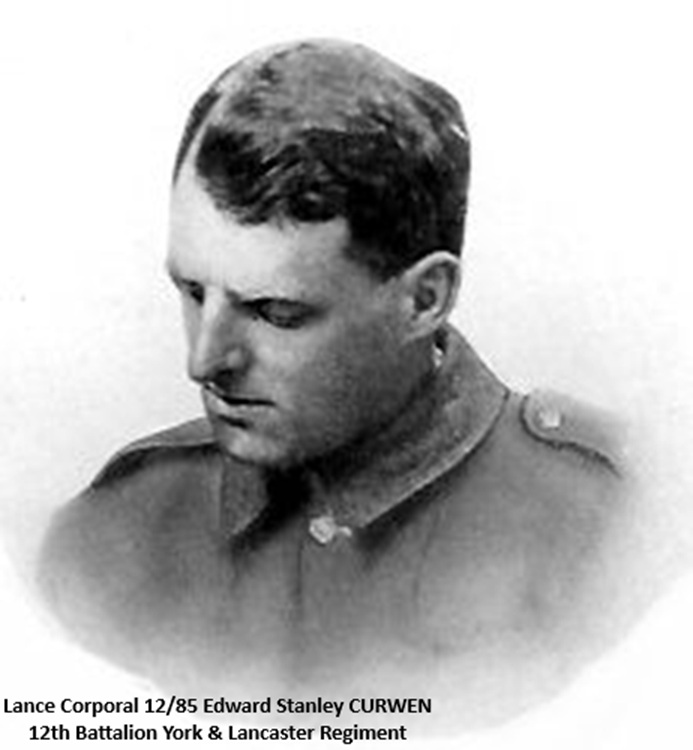
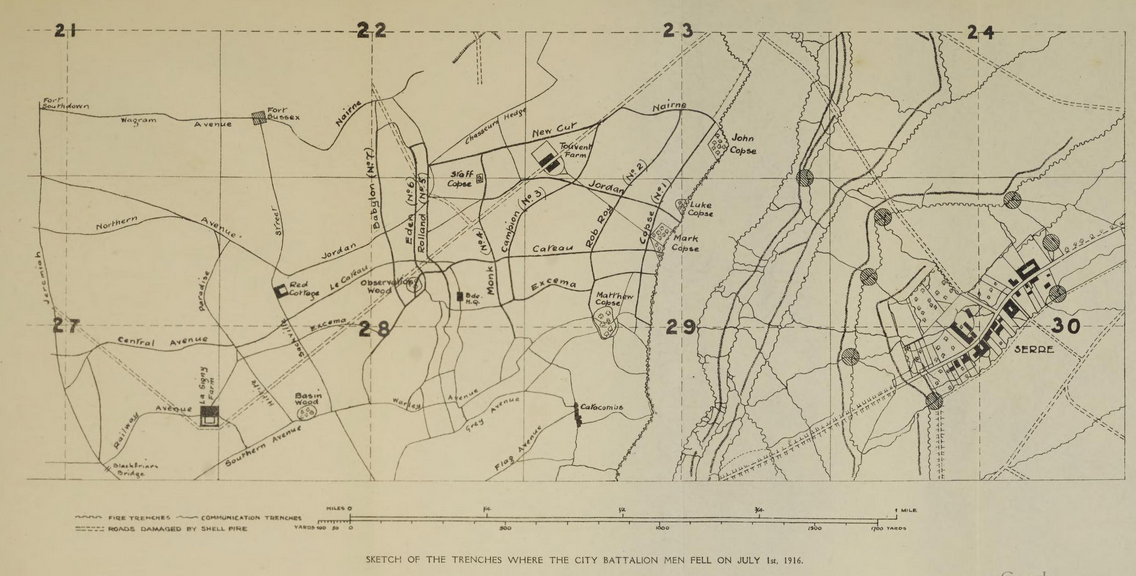
Edward is listed as being killed in action on 1st July 1916, the first day of the Battle of the Somme. The following description of events leading to Edward's death is taken from the Internet Archive Book The History of 12th Service Battalion York & Lancaster Regiment by Richard A. Sparling. Click here to read it. June 30th 1916June 30th - Now the second Y day opened sadly. It was seen that the commanding officer Lt Col. Crosthwaite was seriously ill, and Major Plackett was hurriedly recalled from the Divisional School, where he had been commandant, to assume command. The gallant colonel, who had shown such contempt for danger, was suffering from the effects of batterings received at Ypres in the early stages of the war and had to be taken to hospital. Painful and bitter indeed did he find the parting, for he was proud of his splendid Battalion ‘his boys.”’ The first intimation the troops had that all was not well was at 11 a.m., when Major Plackett took command of a battalion parade drawn up for an address by the corps commander. The corps commander, Sir Aylmer Hunter Weston, made a rousing speech. He spoke swiftly and confidently of the advance to be made on the morrow, but emphasized the importance and difficulties of the task allotted to the Sheffield Battalion. The chances of success were exceedingly great, for the British had superiority in numbers, in artillery, in every arm, and in equipment. The Battalion was fighting for the highest of ideals—for the defence of home and Empire. But your lot is a very heavy one, and a huge responsibility is shared equally by every individual. No individual soldier may say he has no responsibility. The 29th Division, on your left, performed glorious feats of arms at Gallipoli; the 4th Division, on the right, did wonders in the great retreat from Mons. The feats of these divisions will never be forgotten as long as the world endures. You are Englishmen, even as they, and now you have your opportunity to shine. You will have to stick it. You MUST stick it. I salute each officer, N.C.O., and man.”’ At 3pm the following message was received from the 94th Infantry Brigade: Tomorrow, July 1st, will be ‘‘ Z’’ day. Zero will be 7.30 a.m. At 7pm the assaulting troops moved off from Warnimont Wood to march to the assembly trenches behind John Copse and Mark Copse. No music as they slowly wended their way down the woodland side. All faces expressed determination. A lump rises in the throat. What were the thoughts of these wonderful soldiers, who kept their anxieties to themselves? July 1st 3.45am to 7.29am3.45am - 1st July - Lieut. C. Elam reported battalion in position in the assembly trenches. Delay of 24 hours owing to bad condition of trenches. The eastern end of Nairne found to be considerably blown in. Front line badly smashed throughout its length. Monk and Campion trenches in a wretched state. Telephonic communication with brigade found to be cut. Hereafter the only means of communication was runners. 4.5am - Daylight, and the enemy commenced to shell John Copse and front line shelling very violent. In view of this, had the enemy been warned of the attack by observing gaps cut in our wire and the tapes laid out in No Man’s Land? If so, this meant at least three and a half hours warning of the attack. ‘‘A’’ Company reported no sign of the tape which was laid during the night. It had apparently been removed. 6am – C Company report guns firing short on the front line between John and Luke Copses, causing casualties. 6.30am - C Company report heavy shelling. Eight men killed and six men wounded, principally No. 12 platoon. 7.20am - The first waves of ‘‘A’’ and ‘‘ C’’ Companies proceeded into No Man’s Land and lay down about 100 yards in front of our trenches under cover of intense bombardment. Casualties not heavy up to this point. The bombardment reached its zenith. It was terrific. The massed guns, great and small, were thundering their hardest. The noise was no longer a gigantic discord. It became a terrible rhythm, like some superhuman machinery. It drummed in the ears till the men were nearly deaf. The air was full of hurtling death, a constant stream of shells. The suspense during the last few minutes was intense. 7.29am - The second wave moved forward and took up a position about 30 yards in rear of the first wave. The enemy started an artillery barrage commencing at Monk and gradually brought it forward to the front line where it finally settled. The German front line was manned (about one man per yard) by men who had either been lying behind the parados of the fire trench or who had emerged from shelter. July 1st 7.30am to 10pm7.30am - The signal came at last. It was impossible in the tremendous din to pass the message. The troops signalled to each other. The barrage lifted from the German front line, and the first and second waves moved forward to the assault. The third and fourth waves climbed over the top of the parapet. All halted up there in the face of the enemy, just for a second or two, so that they could get into line, and then they started forward at a quick step across the open towards their objective, in section columns. It was a wonderful sight, the waves of humanity going steadily and grimly across No Man’s Land. They were advancing just ‘‘ as if they were on parade.’’ They had to pass through a terrible curtain of shell fire, and German machine-guns were rattling out death from two sides. But the lines, growing ever thinner, went on unwavering. Here and there a shell would burst right among the attackers, and when the smoke cleared slightly the line would be still thinner. Whole sections were destroyed; one section of 14 platoon was killed by concussion, all the men falling to the ground without a murmur. The left half of C Company was wiped out before getting near the German wire, and on the right few of the men who reached the wire were able to get through. As soon as our barrage had lifted from their front-line, the Germans, who had been sheltering in dug-outs, immediately came out and opened rapid fire. Only a few were seen to retire to their second and third lines. The third and fourth waves suffered so heavily that by the time they had reached No Man’s Land they had lost at least half their strength. The German front-line wire was found to be very strong, particularly on the left. A few men of the A and C Companies managed to enter the German trenches on the right of the attack, but in all other parts of the line the troops were held up and shot down. The few survivors took shelter in shell-holes in front of the German wire and remained there until they could get back under cover of darkness. What torture the troops endured in the shell-holes they alone knew. 8.35am - Fighting in progress in German front line trench. Enemy put shrapnel into his own front line. 8.45am - The enemy barrage in our front line exceptionally intense. 13th Y. and L. suffer heavy casualties when attempting to go to the aid of the 11th East Lancs. Regiment. They were not able to get beyond our front line, and were ultimately ordered to reform in Monk trench. The enemy’s barrage at this particular time appeared to be remarkably well observed, and it was invariably concentrated on trenches where troops were massed. 9.5am - Six platoons of the 14th Y. and L. reported making good progress under heavy fire, with our left flank fire trench facing north. They were only seen as far as the German second line trench, until by 10.35 a.m. there were apparently none of them left to carry on. 9.18am - German artillery firing on his second line. 10.15am - The German barrage on his first and second lines removed, and German bombing parties seen to work up communications into front line. 10.30am - Major A. R. Hoette wounded in John Copse. 10.45am - At odd intervals small groups of Germans seen in their first line, standing up on the fire step shooting at the wounded and the dead. 1.0pm - Battalion H.Q.’s moved to Mark Copse, as John Copse was full of wounded. 8.21pm - Battalion reply to Brigade message inquiring as to strength, ammunition, bombs, Lewis guns, Strength of battalion - 10 men unwounded. These are runners and signallers. Have no Lewis guns. 3,000 rounds S.A.A. 350 bombs. Lewis gun pans nil.’’ 10.00pm - It appeared certain that small parties of the Battalion penetrated to the third and fourth German lines, and that a few ultimately reached Serre. Furthermore, three officers reported that at half-past ten in the morning the enemy turned his own artillery on Serre, 700 yards behind his own front line. July 2nd 19161.30am to 3.15 on July 2nd. Messages received saying information had come to hand that about 150 of our men had penetrated the front line opposite Mark Copse, and were still maintaining their position in the German front line. Every effort was to be made to get into touch with them and withdraw them. Two officer patrols were sent out from Mark Copse with men borrowed from 14th Y. and L. These went out into No Man’s Land and approached the German wire. No signs of any fighting were apparent, and wounded men who were met and brought in stated that any men left in the trenches had become casualties and unable to offer further resistance. Patrols consequently withdrew. German machine-guns were very active sweeping No Man's Land, and a large number of Verey lights was sent up. Lieut. H. Oxley was slightly wounded. |
| Personal & Family History |
| Birth Date/Place | Baptism Date/Place |
|---|---|
| 1 Jan 1879 in Plumbland, Cumberland | |
| Parents Names | Abode |
| Rev. Edward Hassell Curwen and Eleanor Maria Curwen | Plumbland Rectory, Kirkandrews, Carlisle |
| Schools | Colleges |
| Carlisle Grammar School 1891-98 (School Obituary) | Queen’s College, Oxford 1898-1902 |
| Address History | Employment History |
| 1879 - Plumbland Rectory, Kirkandrews, Carlisle | 1891 - Scholar at Carlisle Grammar School |
| 1891 - Plumbland Rectory, Kirkandrews, Carlisle | 1901 - Student at Queens College, Oxford |
| 1901 - Plumbland Rectory, Kirkandrews, Carlisle | 1910 - Asst. Master at Rotherham grammar school |
| 1911 - Fern Bank, Moorgate Grove, Rotherham | 1911 - Asst. Master at Rotherham grammar school |
| 1914 - Fern Bank, Moorgate Grove, Rotherham | 19?? - Master at Leamington College for Boys (year unknown) |
Educational History:
- Attended Carlisle Grammar School 1891-1898
- Matriculated with a Thomas Exhibition Scholarship in 1898
- Attended Queen’s College, Oxford 1898-1902
- Graduated B.A in 1902
- Graduated M.A in 1910
- Assistant and/or Master at Leamington College for Boys
- Assistant Master at Rotherham Grammar School
