
South Warwickshire Family History Society War Memorial Transcription Project
The Fallen Men of South Warwickshire - World War One |
|
|

|
Military History |
| Theatre of Death | Medals | Commonwealth War Grave or Memorial |
|---|---|---|
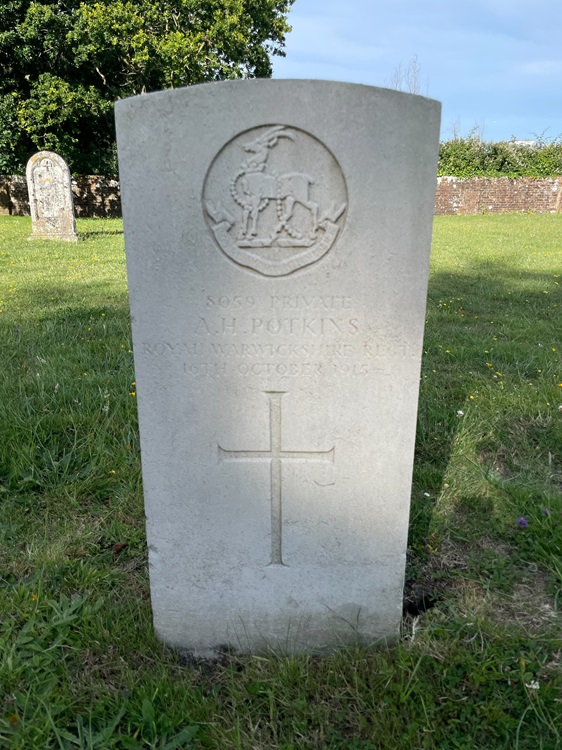
| Home | 1914 Star & Clasp, British War & Victory Medals | Parkhurst Military Cemetery |
| Arrived in War Theatre | Medal Citation (if app) | SWFHS Area Memorials |
| 19 Oct 1914 in France | ~ | Warwick (Eleanor Cross) War Memorial |
| Action, Battle or Other Reason Killed | Date and Place Enlisted | |
| Died in an accident near Albany Barracks | 1901 in London | |
| Place of Death | Previous Regiments or Units | Other War Memorials |
| Horsebridge Hill, Isle of Wight | ||
Original Enlistment
From his service number, 8059 it appears that Arthur enlisted at some time between 13 Feb 1901 when #7683 was issued and 1 Mar 1902 when #8480 was issued.
Circumstances of Death
|
Arthur is listed as having died on 16 Oct 1915. His army pension card states that he was accidentally suffocated whilst on active service. An article in the Isle of Wight Mercury on 22nd October 1915 is transcribed below. SOLDIER SUFFOCATED IN A DITCH The Coroner held an inquiry respecting the death of Arthur Henry Potkins, 33 years of age, who was found dead in the highway at Parkhurst early on Saturday morning. Private Herbert Smith identified the body, and said deceased was a member of the 3rd Battalion Warwickshire Regiment, of 2, Clarence House, 133, Essex Road, Islington. The deceased and Harrison were out together on Friday night. They went to the Stagg Inn, Horsebridge Hill, between twenty minutes to seven and seven o'clock and left at nine o'clock, closing time, the deceased going ahead. Witness did not see him again on the road. Harrison and witness answered to his name at 9.30. He thought the deceased had already gone in. They had been drinking there some time. He did not see the deceased sitting by the side of the road. If he had he would have picked him up. They did not pass any soldiers. He had been a chum of the deceased for seven years. - By Inspector Sibbick: He accounted for his cap being found by the side of the deceased next morning, because it was a favourite trick on his part to take a comrade's cap. Deceased took witness cap in the public house. Private Bertram Harrison said that when they come out deceased went on in front. He called out his nickname, "Pott," but he got no answer. They had been drinking, but he was sober. Witness reached the barracks at 9.40, and found that deceased was not there, and he never saw him again. Smith told him going down the hill that Potkins had his cap. Alfred Ernest Denham, licensee of the Stag, said when the soldiers left they were all capable of taking care of themselves. They all had their caps. There were no other soldiers in the bar that evening. William Early, Rosebank Cottage, Horsebridge Hill, said he arrived home at 9.15 on Friday night, and found two soldiers opposite his gate in a ditch. Half-an-hour later he went out, and heard two men snoring in the ditch. He did not recognise them as it was foggy. At 10.15, or thereabouts, whilst going to bed he heard two men singing. At one next morning he heard talking. When he got up he saw an overcoat belonging to a soldier and two caps, and he also saw deceased lying in the road. He heard no quarrelling. William Legge, Noke Common, Northwood, a labourer, said he found the deceased at 6.30 a.m. on Saturday, just below the chapel on the other side of the road, about four feet from the hedge. He had his hand doubled up and dug in the ground, as though he had been trying to get up. He was quite dead. There was an overcoat and two caps lying near. There was no mark of violence. Dr. Underhill said he made a post-mortem on Saturday. There were no marks of external violence. The brain was in a congested condition, and there was a marked smell of alcohol. He thought death was due to asphyxiation, but having regard to the position in which the body was found he might have been accidentally suffocated. The Coroner said it seemed to him that these men were badly intoxicated, and it made it very difficult to come to a decision. However, he thought they might accept the doctor's theory. Would the jury like the case adjourned in order that he might issue a subpoena for the attendance of Lieutenant James Long, the R.A.M.C. officer who received the deceased after his death, and who ought to have been present. Fortunately Dr. Underhill had cleared up the matter so far. The jury decided not to adjourn the inquest and returned a verdict to the effect that deceased was accidentally suffocated. |
| Personal & Family History |
| Birth Date/Place | Baptism Date/Place |
|---|---|
| 16 Jan 1881 in Deptford | 17 Dec 1882 at Deptford, St. Paul |
| Parents Names | Abode |
| Charley and Louisa Caroline Potkins | Deptford, London |
| Wife and Marriage Details | Children |
| Mabel Elizabeth Potkins nee Brennan | Eileen Louisa born 1907 | Adelaide born 1912 |
| 13 Dec 1904 at Croydon, St. John | Arthur Henry born 1915 |
| Schools | Colleges |
| ~ | |
| Address History | Employment History |
| 1881 - 36 Edward Street, Deptford | 1901 - Private in Royal Warwickshire Regiment |
| 1891 - 46 Dacca Street, Deptford | 1904 - Private in Royal Warwickshire Regiment |
| 1901 - British Army | 1908 - Soldier in Royal Warwickshire Regiment |
| 1904 - 7 Alpine Road, Rotherhithe (marriage) | 1913 - Soldier in Royal Warwickshire Regiment |
| 1908 - Cardalls Court, Brook Street, Warwick (baptism) | |
| 1911 - 33 Coten End, Warwick (family) | |
| 1913 - Military Barracks, Malta (Court Martial Record) | |
| 1915 - 2 Clarence House, 133 Essex Road, Islington | |
- Warwick War Memorial Project Biography
- Arthur is not with his parents on the 1891 census when they were living in 46 Dacca Street, Deptford
- Arthur's son Arthur Henry was killed in March 1924, aged 8, when he was hit by motor car he had ran in front of. He died in Leamington.
