
South Warwickshire Family History Society War Memorial Transcription Project |
|
|


|
Military History |
| Theatre of War | Medals | Commonwealth War Grave or Memorial |
|---|---|---|
| France and Flanders | 1914-15 Star, British War & Victory Medals | Thiepval Memorial |
| Arrived in Theatre | Medal Citation (if app) | SWFHS Area Memorials |
| 30 Mar 1915 | ~ | Whitnash |
| Action, Battle or Other Reason Killed | Date and Place Enlisted | Other War Memorials |
| Battle of Le Transloy (Somme) | December 1914 at Aylesbury | Masonic Roll of Honour |
| Chesham War Memorial | ||
| Place of Death | Previous Regiments or Units | |
| E of Gueudecourt (see map below) | ||
Circumstances Leading to Death
The Attack of the 7th October - Courtesy of the Lightbobs website
On the 2nd October Preliminary Orders, issued by the 20th Division, outlined coming operations. The intention was that the Fourth Army should attack the line Le Transloy-Thilloy-Warlencourt-Faucourt on or about the 10th October, the attack being made by the 4th and 6th Divisions on the XIVth Corps front. To open the way for these operations, it was necessary to establish a forward line (known as the Brown Line), and the task of driving the Germans out of this line was allotted to the Reserve Divisions, with whom the French would be cooperating on the right.
This preliminary attack was to be made, about the 5th or 6th October, by the 41st, 12th, 20th, and 56th Divisions (in that order from left to right) against the portion of the German Line known as the Meteorological Trenches, since they had received names such as Rainbow, Cloudy, Misty, Gusty, Rainy, etc. The weather was so inclement that operations were postponed until the 7th October, on which day at 1.45 p.m., despite the rain and consequent mud, the assault was launched.
The Orders issued by the 60th Brigade are given below in detail, and the action of the 6th Battalion is described in the Report which follows. Suffice it to say here, therefore, that the attack as a whole was fairly successful. The two Divisions on the left (41st and 12th) met with such heavy resistance that they were unable to make much progress. The 20th Division, on the right of the 12th, were more fortunate, and, in spite of all obstacles, succeeded in carrying their objectives and consolidating them. The 56th Division, on the right of the 20th, also won ground, though later in the day they and the French were pushed back again by a German counterattack.
Report of the Actions of the 6th Oxford and Bucks Light Infantry - From the Battalion War Diary
By Major J. E. Osborne, Commanding the Battalion. [Ref. Map Sheet 57 c. S.W.] - Transcribed by The Lightbobs website
On the 7th October zero hour was 1.45 p.m., when, in accordance with 60th Brigade Operation Orders, the Battalion left its trenches and attacked Rainbow Trench their 1st Objective [Blue Pin Marker on map], which runs from about N.28.a.1.4 to about N.28.c.1 ½ .1 ½ [Red Line on map]. The leading waves moved out of the British line close up to our barrage, arrived at the German barbed wire (about 40 yards in front of our trench), and lay down.
By Major J. E. Osborne, Commanding the Battalion. [Ref. Map Sheet 57 c. S.W.] - Transcribed by The Lightbobs website
On the 7th October zero hour was 1.45 p.m., when, in accordance with 60th Brigade Operation Orders, the Battalion left its trenches and attacked Rainbow Trench their 1st Objective [Blue Pin Marker on map], which runs from about N.28.a.1.4 to about N.28.c.1 ½ .1 ½ [Red Line on map]. The leading waves moved out of the British line close up to our barrage, arrived at the German barbed wire (about 40 yards in front of our trench), and lay down.
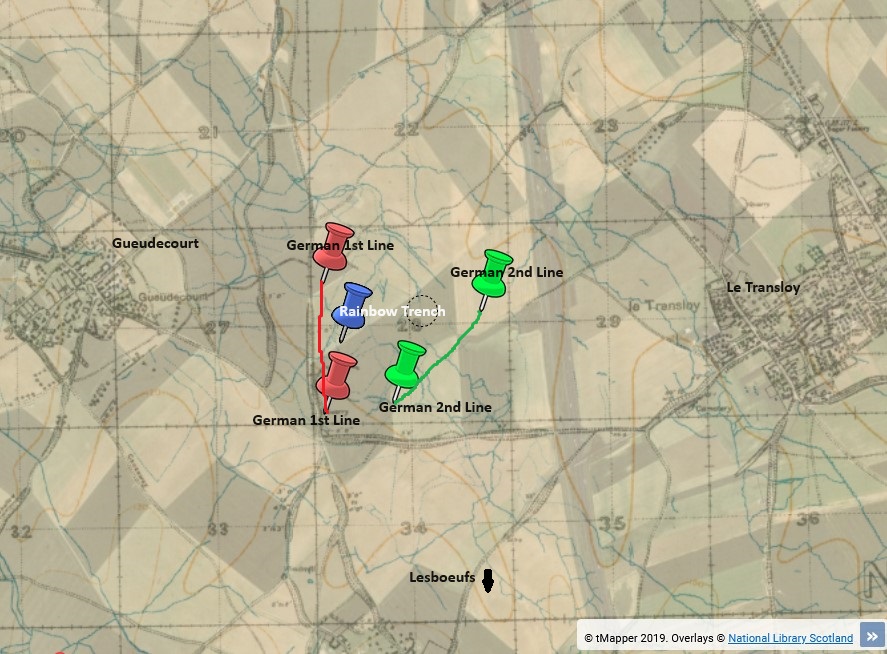
Click for larger map
The enemy had manned his parapet some 60 yards to our front, and was delivering a very hot fire from 6 machine-guns and from rifles, to which our troops replied. Shortly afterwards the advance began again; some men were able to crawl through the wire; others were able to move round through the gaps; others, by placing their feet on the top strand of the wire, were able to get through. The wire obstacle was one single length of barbed concertina wire, extending along the whole of the frontage of the Battalion's left company. It was about 2 ½ feet high, and appeared more of an alarming obstacle than it actually was.
During the period zero to zero + 4 minutes the enemy's machine-gun fire was very intense, but at the latter time it was silenced. The enemy then left their trenches unarmed, and ran back towards their second line. During their retreat our Lewis-guns did considerable damage to them; large numbers were seen to fall, and few Germans got back, those remaining in their front line being bayoneted or captured.
The advance from the first German line to the second, a point about N.22.c.8.2. to N.28.b.7.1.[Green Line in Map] was accomplished with comparatively little loss, although some casualties occurred from snipers on our extreme right, who took advantage of that flank being temporarily in the air. Shortly afterwards a portion of the Division on our right pushed forward their attack and commenced digging in; thus, by joining up with our troops, they made our extreme right secure. The consolidation of this position was at once commenced, our troops having reached their final objective.
This attack was launched in conjunction with the 56th Division on our right and the 12th Division attacking on our left. The Battalion lost most of its officers early in the attack; the Company 'Commanders of A, B, and C were killed, and D Company Commander was severely wounded. The casualties amounted to 13 officers and 230 other ranks. END
During the period zero to zero + 4 minutes the enemy's machine-gun fire was very intense, but at the latter time it was silenced. The enemy then left their trenches unarmed, and ran back towards their second line. During their retreat our Lewis-guns did considerable damage to them; large numbers were seen to fall, and few Germans got back, those remaining in their front line being bayoneted or captured.
The advance from the first German line to the second, a point about N.22.c.8.2. to N.28.b.7.1.[Green Line in Map] was accomplished with comparatively little loss, although some casualties occurred from snipers on our extreme right, who took advantage of that flank being temporarily in the air. Shortly afterwards a portion of the Division on our right pushed forward their attack and commenced digging in; thus, by joining up with our troops, they made our extreme right secure. The consolidation of this position was at once commenced, our troops having reached their final objective.
This attack was launched in conjunction with the 56th Division on our right and the 12th Division attacking on our left. The Battalion lost most of its officers early in the attack; the Company 'Commanders of A, B, and C were killed, and D Company Commander was severely wounded. The casualties amounted to 13 officers and 230 other ranks. END
| Personal & Family History |
| Birth Date/Place | Baptism Date/Place |
|---|---|
| c1882 on St. Helena | |
| Parents Names | Abode |
| Maj. George Martin & Rosa Bella Tait Chimes | Gordon House, Whitnash |
| Schools | Colleges |
| ~ | |
| Address History | Employment History |
| 1891 - Gibraltar Army Base | 1911 - Foreman Joiner / Carpenter |
| 1901 - Windsor Army Base | |
| 1911 - 273, Hivings Hill, Chesham | |
| 1914 - Gordon House, Whitnash | |
|
