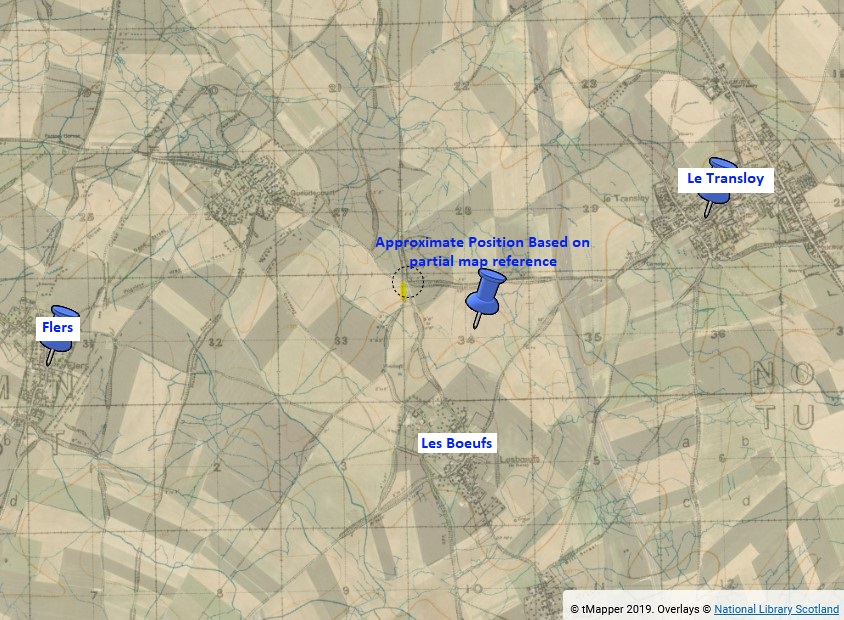
At 1 p.m. the advance continued. As a matter of fact men were going forward about 4 minutes before the hour, but the barrage ruled the pace. Casualties from our own barrage were slight, if any at all. By the time the eastern side of the village was reached units were much mixed.
There were, besides my own Battalion and the 10th and 11th R.B., some of the 10th K.R.R.C. and Somerset Light Infantry, as well as some of the Duke of Cornwall's Light Infantry (5th Division). Units were reorganized here as far as possible.
The Somerset Light Infantry, at my request, kept back a portion of the battalion in this position, when the advance was continued up to Ginchy—Wedge Wood road, to look after the right flank, as a number of Germans were visible in the open, south-west of Leuze Wood, and our contact with the 5th Division on our right did not seem complete.
At 2 p.m. the whole line went forward up to the Ginchy - Wedge Wood road, and reached it with very little opposition, but a number of prisoners were taken from dug-outs on the road. The consolidation of the position at once began, but there was a shortage of tools. It was evident that the 5th Division had not been able to advance up the spur south-west of Leuze Wood, and that that spur and the wood were still in the hands of the Germans. I therefore decided not to move forward from the road to the final objective ordered, that is, with the right flank of the 59th Brigade line just outside the south-west corner of the wood.
The 1st Duke of Cornwall's Light Infantry were now in touch with us on the road-line, on our right; the 8th Munster Fusiliers were on our left, at the Cross-Roads. There were then in the 59th Brigade area on the Ginchy - Wedge Wood road the following troops under Lieut.-Colonel E. D. White: 200 10th R.B., 200 11th R.B., 100 10th K.R.R.C., and 300 6th Oxford and Bucks Light Infantry. The Somerset Light Infantry were digging themselves in, in support, close behind.
An officer's patrol went up by the Quarry to the south-west edge of Leuze Wood and found no one there. During the night (3rd/4th September) patrols were working in the valley below us, but could not work up to the ridge and wood in front owing to our artillery fire. The enemy made no attacks.
Nearly all the losses suffered by the Battalion were from shell and machine-gun fire before reaching the second Sunken Road, and more especially before reaching the first Sunken Road. During the clearing of dug-outs at the final position one case occurred of a "P" bomb being thrown in at one door of a dug-out and the smoke coming out at the other door without dislodging the Germans, who, however, did come out when Mills bombs were thrown in.
Eight Company Officers, 72 N.C.O.'s, and about 200 men were casualties, mostly early in the attack, and I think that much credit is due to the men and to the few leaders left in getting on the right objective.