
South Warwickshire Family History Society War Memorial Transcription Project
The Fallen Men of South Warwickshire - World War One |
|
|

|
Military History |
| Theatre of War | Medals | Commonwealth War Grave or Memorial |
|---|---|---|
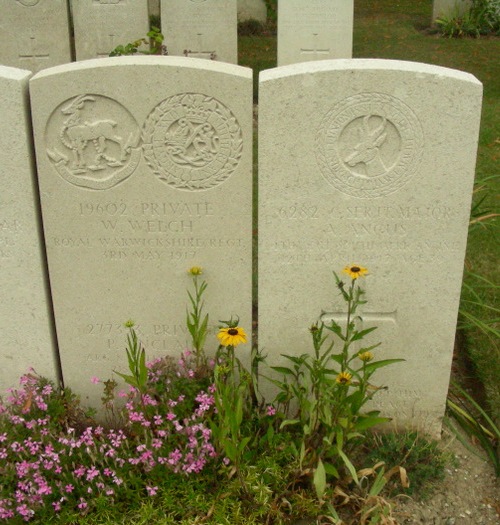
| France & Flanders | British War & Victory Medals | Brown's Copse Cemetery, Roeux |
| Arrived in Theatre | Medal Citation (if app) | SWFHS Area Memorials |
| After 1 July 1916 in France | ~ | Studley War Memorial |
| Action, Battle or Other Reason Died | Date and Place Enlisted | Other War Memorials |
| Third Battle of the Scarpe (Arras) | On or after 3 May 1916 in Redditch | ~ |
| Place of Death | Previous Regiments or Units | |
| Fampoux | ~ | |
Circumstances of Death
|
William is listed as being killed in action on 3 May 1917.The following narrative of the actions of that day were provided by Alan Tucker on the Great War Forum. Unfortuately is appears that Alan has since passed away. 1st Battalion, Royal Warwickshire Regiment - The Third Battle of the Scarpe by Alan Tucker Part 1 - 2nd/3rd MayWhen active operations began in the Battle of Arras the battalion consisted of 38 officers and 957 men. They now arrived in the back area with 29 officers and 696 men. The Brigadier General sent his congratulations for the “endurance of all ranks under the very trying circumstances”. The XVII Corps commander, Lieutenant General Charles Ferguson, voiced similar sentiments to the Divisional Commander - the operations were a “great success since the first day when we broke through the 4th German system of trenches and…held the line for nearly a fortnight without relief under the worst possible conditions of weather” (1665). The ‘grit’ and endurance’ were “worthy of the best traditions of the Old Army of which they are still representative”. At Ambrines five subalterns and 58 other ranks joined from the base. On April 23 there was a further move to Beaufort for training, sport and rest. During this period there was some evaluation of the earlier operation. Five days later the battalion set off for Y Huts, west of Etrun, north west of Arras, and, a day later, into Arras where Battalion HQ was established at 56, Rue des Augustines. They now prepared to return to the trenches in the area of Corona and Ceylon Trenches which curled south and east of the hamlet which contained Rouex Station, the Chateau and the notorious Chemical Works and between there and the main village On the morning of May 2 the battalion’s front line trenches were evacuated to enable heavy guns to bombard the Chemical Works, Cemetery and Chateau. They were re-occupied at dusk when new operational orders for May 3 were issued as part of a wider, major Third Army thrust with three army corps along a six mile front. 10th Brigade and the 1/Somerset Light Infantry of 11th Brigade were to attack the German position between Fresnes-les-Montabon and Plouvain. They would be on the right of IV Division. The Warwicks were to be on the Brigade left with the first wave tasked with taking the Black Line (Roeux) and the second wave the Blue Line (between Rouex and Plouvain), the second objective. Each wave was to consist of two lines twenty yards apart followed by moppers-up. The second wave was to assemble in Coop Trench and their moppers up had to concentrate on the Chateau, houses along the Roeux-Gavrelle road and the Chalk Pit. ‘A’ company did not have a direct role and were to remain on the Bank near Battalion HQ and act as carriers. The attackers had to be in position by 11.30 p.m on May 2 with zero hour at 3.45 a.m on May 3. A creeping barrage would lift at fifty yards a minute. Before each lift smoke would be fired and gas from Livens Projectors would be used if the wind was favourable. The Black Line would be consolidated by digging lunette trenches. The second wave would be helped by two sections of the 10th Machine Gun Company. The plan required a contact aeroplane to pass over at 6.15 a.m. The most advanced troops only would light red ground flares. The plan avoided a direct attack on Roeux from the west and sought to turn the village from the north. Lieutenant Colonel Forster wrote a detailed narrative/diary of the battalion’s operations from May 3 to the night of May 4/5 – dated May 5. At 12.30 a.m. on May 3 they had formed up in their Assembly positions. An Advanced Signal Station (telephone and runner) had been established next to an observation post with the Inteligence Officer at the junction of the front line with the railway embankment. At 4.45 a.m. a message was received from Captain W.G Cox, commanding ‘B’ company, that the second wave was being held up by machine gun fire from a shell hole south of the Chateau. Soon afterwards eight German prisoners were brought in, mainly from the 252 Regiment. Then runners from the Advanced Signal Station brought a message that the first wave had got ‘well away’ but were met with machine gun fire. ‘D’ company appeared to have got into the first German line and the houses although a wounded man had reported many casualties. A message timed at 6.50 a.m. reported that the Household Battalion was held up at a line in houses near the Cemetery. The left Warwicks’ company (‘D’) was ‘hung up in front of houses in shell holes north of the Chateau’. The Germans were still holding on to the northern extremity of the Chateau and buildings north of it. ‘D’ company had met heavy machine gun fire going over the parapet and were now starting to fall back to the original line. The 10th Machine Gun Company had also fallen back. At 10.45 a.m. an officers’ patrol was sent through the Chateau grounds. Second Lieutenant Smith reported back at 12.30 p.m…“that he had with great difficulty, owing to sniping + MG, reached close up to the Chateau on south side of wall but could get no further east and could see no troops of ours near the Chateau holding out on the road south and east of Chateau”. At about noon a message came from Brigade that ‘it was definitely known that some 150 men of the Brigade of all battalions were consolidating on the Black Line’. A German counter-attack on the Black Line at about 4 p.m was repulsed by artillery fire. At 7 p.m. Second Lieutenant McLeod came in wounded and reported that he had come from the Black Line to find out the situation of other troops. “He was fired on most of the way and was wounded when near the Chateau. He crawled in. His statement was that there were about 150 men of Lancs Fusiliers, R War R (70) and HB (Household Battalion) who were digging in on 1st objective, the Black Line, but there were no troops on their right”. The Colonel’s conclusion was that “The attack in the morning failed greatly due to the darkness and therefore difficulty the Mopping Up Coy had in finding the entrances in the Chateau and surrounding houses. I also think the Moppers were not strong enough in numbers. From what information I could get I think the 1st wave got through to the Black Line and commenced consolidation there and eventually were taken being isolated”. Others noted the inadequate preliminary barrage, the distance to be covered by reduced numbers because of earlier losses and the barrage outdistancing the attacking troops. Part 2 - 3rd/4th MayNew orders were received at 9 p.m. for the battalion and the Royal Irish Fusiliers to establish five posts each on their line. Captain Strevens commanded the party sent out at 2.30 a.m.on May 4 ‘to establish themselves in Trench south of Chateau and establish posts east of the Roeux-Gavrelle road. The Colonel reported afterwards… “He advanced from our front line from junction of Corona with front line to south wall of Chateau in four lines – each line consisting of 20 all ranks – 1st line chiefly bombers, Lewis guns with 3rd line. Immediately the 1st line had got over our parapet Very lights were sent up by the Germans and the 3rd and 4th line were not clear of our front line before MG fire commenced. 2nd Lt Dacombe, who was in command of 1st line, pushed forward and succeeded and gaining the centre portion of the German Tr – this Trench had a MG at Chateau end and a Bomb Post southern end. He was unfortunately quickly bombed out – before the other lines had time to support him - they had had difficulty to get along owing to MG fire. 2nd Lt Dacombe then collected the second and third line (the officer with 3rd line had been wounded quite early) and he attacked the Trench and again gained the Trench and again gained a footing in it – but was unable to maintain his position owing to flank MG fire and rifle grenades from east of the road. Captain Strevens…therefore decided that he was not strong enough to gain his position and covered the retirement of the others with his 4th line. 2nd Lt Dacombe and a few men did not get back till 8 a.m”. The action had failed – the trench could not be gained so posts could not be established on the eastern side of the road. The Colonel’s conclusion was that the trench would have been taken if 12th Brigade had appeared on the left but noted that the arrangements had been made in a great hurry. At night the battalion was relieved by the 1/Hants and returned to dugouts and shelters in a railway cutting west of Brigade HQ. The Royal Irish Fusiliers came back to the same position. During the period since April 30 one officer and five other ranks had been killed, six officers and 78 other ranks wounded, four officers missing as well as 109 other ranks. CWGC recorded 62 deaths on May 3(1666). The battalion rested in the same position on the following day and cleaned up ‘as much as possible’. At 3 a.m. on May 7 the Germans fired about 50 4.2s into the cutting resulting in three casualties. There were also five casualties that night in a working party of one officer and five men working on Colne Trench. Late in the evening on May 8 the battalion relieved the 2/Seaforths and part of the Royal Irish Fusiliers in the front line at Cap, Care, Ceylon and Corona Trenches. The artillery of both sides was very active on the following day when Temporary Captain G.Evezard was seriously wounded and died at the 1st Canadian CCS on the same day. On May 10 the front trench troops evacuated the line to enable heavy guns to bombard the Chemical Works, Chateau and Cemetery all day. ‘B’ company came back to Crete Trench and the other three to Crump Trench. There was a return to the front line at dusk although they all returned to Crete Trench on the same night after relief by the Household Battalion. |
| Personal & Family History |
| Birth Date/Place | Baptism Date/Place |
|---|---|
| Apr Qtr 1884 in Cookshill, Alcester | 1 Jun 1894 in Inkberrow |
| Parents Names | Abode |
| William Alfred and Emma Welch | Littlewood Green, Studley |
| Wife and Marriage Details | Children |
| Elsie Maria Welch nee Bennett | Ida b 14 Oct 1906 | Dorothy b 6 Jul 1908 |
| 25 Dec 1904 at Studley, St. Mary | Elsie b 12 Jul 1910 | Denis b 12 Apr 1915 |
| Schools | Colleges |
| ~ | |
| Address History | Employment History |
| 1884 - Arrow, Alcester | 1891 - Scholar |
| 1891 - Brockhill Road, Redditch | 1901 - Servant - Groom |
| 1901 - Redditch Road, Studley | 1904 - Labourer |
| 1904 - Littlewood Green, Studley | 1911 - General Servant - Groom |
| 1911 - New Road, Studley | |
| 1915 - New Road, Studley |