
South Warwickshire Family History Society War Memorial Transcription Project
The Fallen Men of South Warwickshire - World War One |
|
|

|
Military History |
| Theatre of War | Medals | Commonwealth War Grave or Memorial |
|---|---|---|
| France & Flanders | British War & Victory Medals | Messines Ridge (NZ) Memorial |
| Arrived in Theatre | Medal Citation (if app) | SWFHS Area Memorials |
| 16 Nov 1916 in France | ~ | Stratford on Avon WW1 Memorial |
| Stratford Holy Trinity Church | ||
| Action, Battle or Other Reason Died | Date and Place Enlisted | Stratford Cemetery Memorial |
| Battle of Messines (1917) | 06 Mar 1916 in New Zealand | Stratford on Avon Boat Club Memorial |
| Place of Death | Previous Regiments or Units | Other War Memorials |
| Messines Ridge | ~ | ~ |
Circumstances of Death
|
Leopold is listed as being killed in action during the successful attack on the village of Messines. The 4th Battalion Report on Operations is transcribed below. 4th Battalion New Zealand Rifle Brigade - 12th June 1917 The Attack on MessinesThe Battalion plus “B” Coy. of 2nd Battalion N.Z.R.B. moved from Bivouac Areas at De Seule at 9.30 p.m. on 6th June 1917. Gas Shells were met with at the entrance to the communication trench with the result that the OC D Coy and 11 men were sent to Aid Post and took no further part in the operations. The Battalion was reported in position at 1.15 a.m. and ready to move at 2.15 a.m. At 3.8 a.m. our machine guns opened an intense fire followed at 3.10 a.m. by the artillery barrage. Almost immediately a number of mines were blown. A great display of enemy signal lights shot up at once. The Infantry moved from their trenches promptly on time and followed closely on the heels of the barrage. Tanks were seen shortly after crossing Hanbury Support but too late to have any chance of catching up with the swiftly moving Infantry. The enemy had kept up a slow steady fire on our trenches throughout the night but was very slow in bringing his barrage down. Our Infantry were clear of the British Front Line and well across No Mans Land before the German barrage came down. When it did arrive, about 10 minutes after ZERO, it was irregular. It was placed on our Front Line and communication trenches but too late to affect our troops. Our men pushed forward at a very rapid rate their pace being regulated by the barrage. Some slight confusion arose crossing the British Front Line trenches troops becoming a little mixed up but once over the parapet they soon shook out into their proper places. On arrival in Messines our men were right with the barrage and as soon as it lifted rushed such parties of the enemy as were visible and then commenced mopping up the cellars. A fair amount of opposition was met with but this was quickly overcome and fighting then took place in and around the various cellars. The smoke bombs proved of the utmost value at this stage and the enemy who had taken shelter in dugouts were soon smoked out either killed or taken prisoner. Heavy machine gun fire was brought to bear on our troops from the village. The troops detailed to capture the Yellow Line pushed forward quickly. At 4.55 a.m. the Right Front Company reported the capture of its objective. The left flank was not then clear and fighting was still going on in MESSINES. At 5 a.m. the Left Front Company was reported in possession of its objective but the situation was not entirely clear. At 5.0am all of Messines south of the CHURCH was clear of enemy troops. At 5am all of MESSINES was then actually in our possession but the left flank was not quite clear. At 6.40am it was reported that all objectives had been gained. At 7.15 a.m. we reported all objectives gained and touch obtained on both flanks with the situation clear. Consolidation was then progressing rapidly. The Aftermath of the AttackENEMY BARRAGE – 10 minutes late – thin and irregular. It came down on our Front Line and Communication Trenches. Battalion HQ’s moving at 4.10 a.m. passed through the enemy barrage without a casualty. ENEMY RESISTANCE – Considerable fighting took place in Messines but it was disorganised and stiff resistance only occurred where the enemy parties had a considerable preponderance in numbers. CO-OPERATION WITH UNITS ON FLANK – was good and the Liaison N.C.O.s kept us well posted as to the situation. BATTLE FORMATION – Enemy resistance was not sufficient to test it thoroughly but the opinion of all officers is that for this class of fighting it is excellent. Rifle Grenades and Lewis Guns proved of great value in dealing with machine guns and “pockets” of enemy troops. A noticeable feature was that the Lewis Gunners could not on account of their heavy loads keep pace with the other troops and this fact is responsible for a number of Germans escaping with their lives. SIGNALLING OUR BARRAGE MACHINE GUN BARRAGE MACHINE GUNS AND LIGHT TRENCH MORTARS WITH BATTALION SPECIAL POINTS - It is the general opinion of the officers that it would have been an advantage if zero had been 20 minutes later as it was rather too dark at 3.10 a.m. The value of the points which have been stressed in the training publications was exemplified. The advantage of keeping on the heels of the barrage was realised by the men and the fact that they did so resulted in numbers of the enemy being dealt with before they realised that our barrage had lifted. Initiative on the part of platoon and section commanders are of the utmost value. Care in seeing that every man taking part in the attack understands the object of it is of primary importance. Once all ranks thoroughly understand the plans of a big step towards success has been made. ADMINISTRATIVE ARRANGEMENTS - With the exception of the medical arrangements these could not very well be improved upon. Supplies of munitions and water arrived in the village before the mopping up was complete. The N.Z.M.C. bearers were late in arriving in the village in fact did not get there until several requests for their services had been made with the result that the fighting troops of battalion headquarters were detailed for the work with improvised stretchers. |
| Personal & Family History |
| Birth Date/Place | Baptism Date/Place |
|---|---|
| 24 Jun 1884 in Stratford on Avon | 22 Oct 1884 in Stratford on Avon |
| Parents Names | Abode |
| John and Mary Morgan | 11 High Street, Stratford on Avon |
| Wife | Marriage Details |
| Mona Marion Morgan nee Robinson | 9 Feb 1916 in Wellington, New Zealand |
| Schools | Colleges |
| ~ | |
| Address History | Employment History |
| 1884 - Stratford on Avon | 1891 - School age |
| 1891 - 11 High Street, Stratford on Avon | 1901 - Builders Apprentice |
| 1901 - 11 High Street, Stratford on Avon | 1911 - Clerk of the Works in Pahiatua |
| 1911 - Pahiatua, New Zealand | 1916 - Architect at Wairau Hospital Board |
| 1916 - Springlands, Blenheim, New Zealand | |
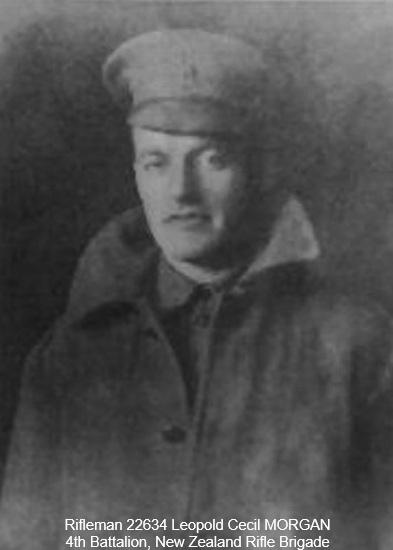
- Photograph Courtesy of Stratford upon Avon Local History Society